



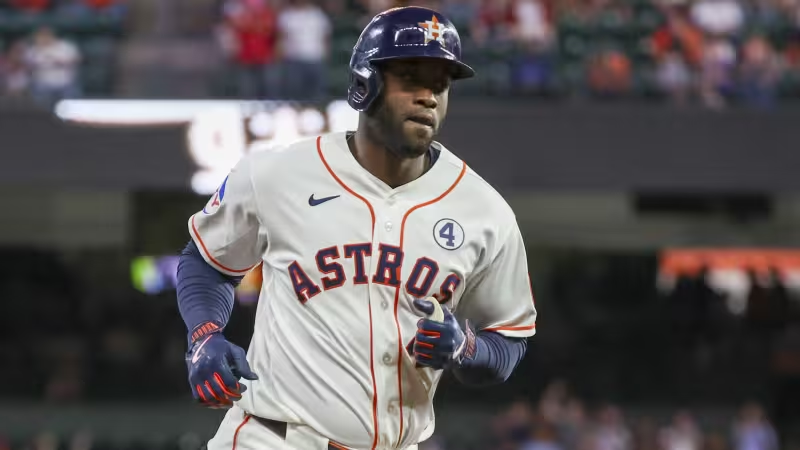
Opposing executives do not expect the Houston Astros to shop Yordan Alvarez before the Aug. 3 trade deadline, reporter Jeff Passan reported, leaving contending clubs to plan around a star bat that could still reshape a market if Houston changes course.
The calculus is simple on paper: the Astros were 28-25 and sitting in fourth place in their division when the report came out, while Alvarez — 28 years old — was producing at an elite level. Through a recent 62-game stretch he had a.316/.426/.649 slash line with 21 home runs, leading the American League in batting average and homers and topping all of MLB with a.649 slugging percentage.

The financial and contractual picture adds to his trade value and his retention. Alvarez is in the middle of a six-year, $115 million deal that leaves him under team control for two more seasons beyond this year; he is owed roughly $53.6 million over that span. That combination — elite, controlled production for multiple seasons — is precisely what makes him a rare, high-value chip on a seller’s market.

And yet the Astros have been sliding. The club is on pace for its worst season since 2014, when it finished 70-92, and carried a minus-35 run differential, one of the worst in the American League. Coming into the year the organization was flagged as having the worst farm system in the league and no top-100 prospect, limiting immediate, draft-and-develop trade currency that would normally sweeten a rebuild.
That tension — a team nudging toward a reset while still holding its most tradable asset — is why rival executives’ read matters. The practical flip side is the speculative market: analyst Tim Kelly floated the Pittsburgh Pirates as a possible landing spot, writing, "It's probably unrealistic, but imagine if the Pirates traded for the aforementioned Alvarez, replacing a struggling Marcell Ozuna." Kelly added, "Alvarez is making good money, but his deal is still relatively team-friendly, and he's under control for two more seasons after 2026, so you could justify giving up significant prospect capital for him." The Pirates, 29-26 at the same point, were mentioned as a hypothetical suitor after winning five of seven games heading into a Wednesday matchup.
With the Aug. 3 deadline approaching, the immediate stakes are clear: contenders weighing whether to surrender premium prospect capital must decide whether to chase a player rival front offices largely expect to remain off the market. For Houston, the choice is binary in practice — hold Alvarez and try to salvage the season or use him to accelerate a roster reset — but the public posture from other clubs is that, as of now, Houston will choose the former.
What to watch in the coming weeks is not rumor volume but symptoms: a deeper fall below.500, a sudden front-office pivot, or a flurry of calls that suggest the club has opened serious discussions. Unless one of those things happens, contenders should plan for Alvarez to be in Houston on Aug. 4; if the Astros’ slide accelerates, that calculation will be the single clearest sign a trade is suddenly possible before the deadline.



