



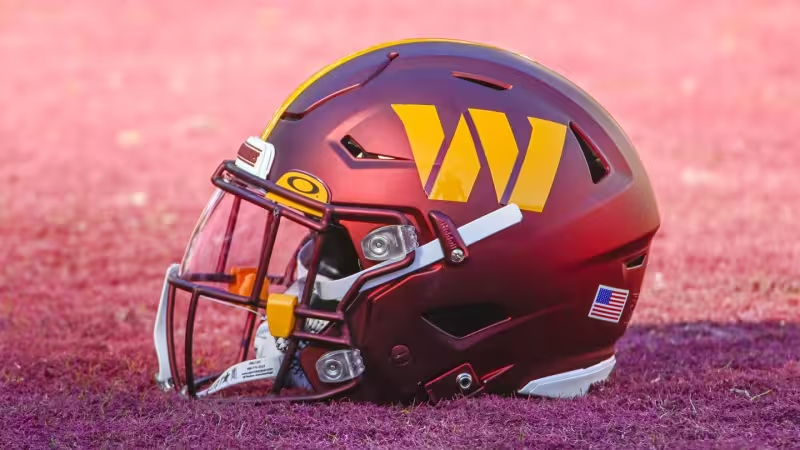
National NFL power polls have placed the Washington Commanders in the lower half of the league this offseason, clustering between 21st and 24th and averaging 22.625 in a recent Sports Illustrated roundup.
The breakdown is concrete: Analytics put Washington at 21st, Sharp Football at 22nd, and both Yahoo Sports and The Ringer at 24th. Those figures are the simplest signal the team has not yet convinced national evaluators that its offseason overhaul altered its standing among contenders.

What pushed the rankings back into the headlines was last week’s Myles Garrett trade, which sparked a fresh round of offseason polls. Sports Illustrated framed its piece as a look at how national voters view the Commanders now — not as a game result but as a snapshot of perception heading into the regular season.
The numbers reflect several specific judgments about roster construction. Observers noted Washington made only six draft picks this cycle and that most evaluators see just one rookie — first-round linebacker Sonny Styles — as likely to have a meaningful role early. That limited draft haul, reviewers wrote, leaves questions about depth and top-end talent after the team’s reshaping.
Commentary diverged on how to weigh those doubts. One evaluator argued his confidence in the organization’s infrastructure and coaching has improved significantly over the past year, even while warning that the Commanders patched holes by signing pricey veterans who still carry flaws. He added that, unless quarterback Daniels is essentially dragged into the postseason, Washington lacks the pieces to reach the playoffs — and that asking Daniels to shoulder that burden again would be unrealistic.
At the same time, other analysts highlighted clear positives from the draft and recent pickups. Sharp Football called Styles a very strong selection for Washington, and one commentator said he also likes the fit of Antonio Williams as a complement to Terry McLaurin. Those endorsements illustrate why the polls do not place Washington at rock bottom: there are young pieces and role complements that could matter in the short term.
The friction is the central story here. Some voters see a team that addressed needs with veterans and one high-upside rookie but still lacks high-impact draft additions; others see a franchise that improved coaching and added targeted contributors who can move the needle. That split explains why national rankings cluster in the low-20s rather than at an extreme.
For Washington, the practical consequence is simple and immediate: preseason perceptions set expectations and influence narratives around early-season results. A slow start will reinforce the lower-tier placement; a hot opening stretch will force voters to re-evaluate how much weight to give free-agent patches versus organic roster growth and coaching progress.
The remaining question is concrete. The polls capture opinion now but leave unanswered whether the overhaul will translate into wins. The next regular-season games and subsequent power polls will be the proving ground — and whether Daniels can be spared the role of single-handedly carrying the offense will be the clearest indicator of whether Washington can climb out of the middle of the pack.



