



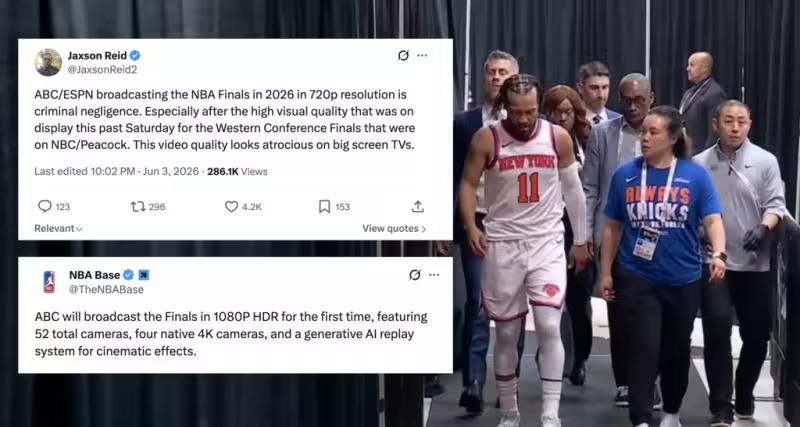
During Game 1 of the 2026 NBA Finals on June 4, 2026, social feeds filled with complaints that the picture on ABC looked washed out, flat or otherwise inferior — even though had publicly billed the Finals as produced in 1080p HDR. ’s promotion made a clear promise: "The 2026 NBA Finals will be ABC’s first NBA Finals presented with 1080p HDR capture and transmission." The short answer to viewers’ frustration is that the feed carried by many households was not the same technical product captured at the arena.
The immediate technical trigger is a split delivery chain. As Kristian Hernández explained, "For this year’s NBA Finals, the App is streaming the game in 1080p HDR (high dynamic range for brighter highlights, deeper contrast, and a wider availability of colors) but the network is transmitting the feed linearly to ABC in 1080p SDR (standard dynamic range)." In plain terms: the App delivers the HDR signal; the live linear feed sent to ABC is a downconverted SDR stream.

That difference matters visually because HDR preserves brighter highlights, deeper blacks and a wider color range that SDR cannot reproduce. Hernández laid out the production flow succinctly: "This means that the original video feeds captured in 1080p HDR at the venue are downconverted for distribution." Downconversion changes how the image maps to a TV’s brightness and color range, and the result can look muted or inconsistent compared with the HDR source.
Distribution and local plumbing add another layer. Not every local affiliate or distribution chain is prepared for a 1080p signal that also contains varying dynamic-range information. As Hernández noted, "Depending on where viewers are watching, their local affiliate might not have the infrastructure to handle a 1080p broadcast of varying dynamic ranges." Between the network’s transmission point and a living-room set, vendors, local stations and cable or satellite providers each perform signal processing that can alter the image.

That explains the pattern from Game 1: homes that tuned in via the App saw the advertised 1080p HDR picture, while many watching ABC’s linear broadcast received a 1080p SDR signal that had been downconverted and possibly reprocessed by local systems. A viewer’s television also plays a role — set processing, HDR compatibility and user picture settings can make two viewers on the same feed see different images.
Streaming paths have fewer of those distribution obstacles. Hernandez observed that "Broadcasts through the network’s own streaming platforms or through OTT distribution, for the time being, are given more freedom to experiment with broadcasts in higher formats." The App therefore represents the most direct route from HDR capture to HDR display for now.
What can viewers do if their ABC picture looks wrong? The practical fix is immediate: watch through the App or another OTT service carrying the HDR stream if you can. Beyond that, the mechanics that produced complaints remain only partly visible to the public. No public list identifies which local affiliates or distribution chains produced the worst degradations during Game 1, and there is no confirmed, network-wide corrective announced that would eliminate those intermediary variables.
The most consequential question left open is also the simplest: which local links in the chain caused the visible drop in quality on specific broadcasts? Until networks, affiliates or distributors disclose chain-level findings or implement targeted fixes, viewers seeking the promised 1080p HDR presentation should rely on the App or OTT feeds; the linear ABC path will continue to be the single workflow still delivered in 1080p SDR and therefore vulnerable to the distribution and equipment issues that surfaced on June 4, 2026.



