




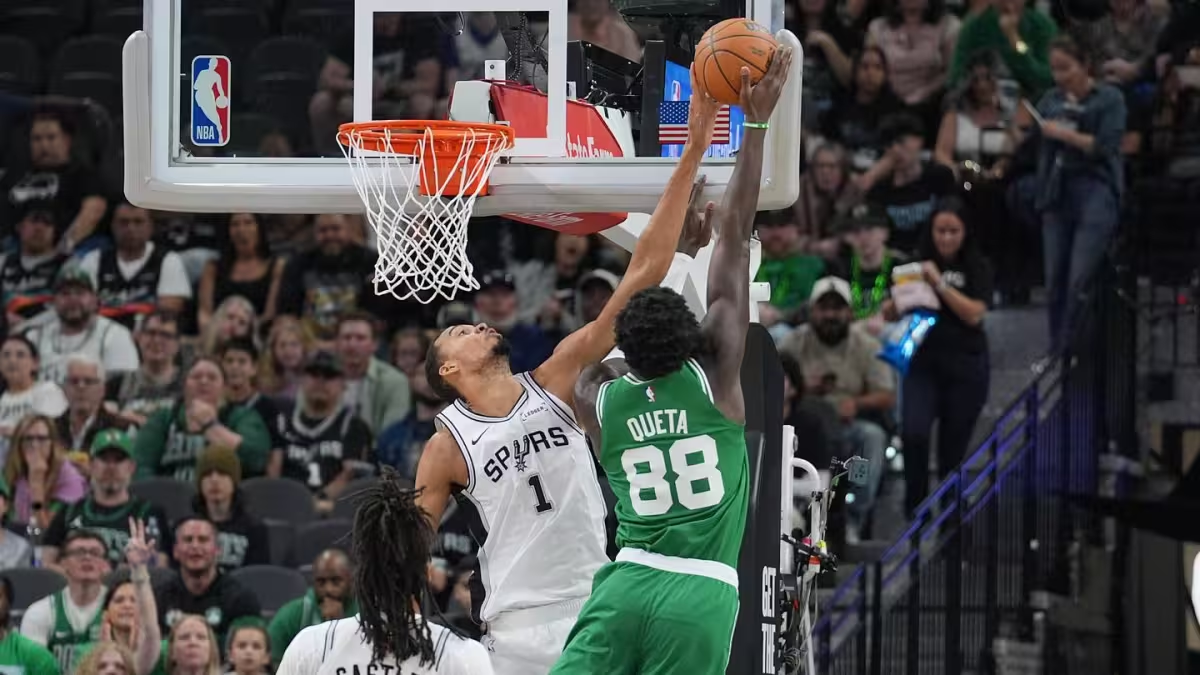
Victor Wembanyama is the NBA's best player and, by this reckoning, the youngest player ever to hold that distinction — making him the 25th individual to be treated as the league’s top player in a season-by-season survey. The phrase wemby age has become shorthand for the historic youth of that designation.
The designation comes from a year-long project tied to Sporting News’ 140th year of publishing, in which the author went through 80 years of NBA history to pick the best player in the world at the end of every season. That methodical, season-by-season sweep is explicit about its purpose: an all-time historical ranking, not a single-game award — and it is an unofficial, partly subjective exercise.

Putting Wembanyama at the top yields one clear headline number: 25th player. That places him in a short list of seasons and men who have been treated as the league’s definitive figure. It also underlines the unusual angle of this project — a long view that emphasizes year-end supremacy rather than formal trophies or single-season awards.
The survey traces a through-line across the league’s early decades. In the 1940s and 1950s, Joe Fulks holds the first crown until George Mikan arrived and immediately took over as the league’s top dog as a rookie. Mikan then won five titles in his seven-year career, the kind of early dominance the retrospective highlights when assigning the season-by-season top slot.

The 1960s read as a duel. Bill Russell and Wilt Chamberlain battled for individual supremacy across that decade. Chamberlain’s peak included three straight MVPs and seven scoring titles; he averaged 50 points per game in the 1961-62 season and, paradoxically, scored just 22 points in a Game 7 loss to Bill Russell's Celtics in the 1961-62 playoffs. Wilt eventually “took the belt” with a title in 1967, only for Russell to reassert his claim the following season after returning from being banged up.
The long list also stacks up cumulative seasons of primacy. Bill Russell and Michael Jordan each are credited with nine seasons as the league’s best player in this timeline, while LeBron James shows up with eight. Those totals are the measuring sticks the author uses to illustrate era-spanning dominance, even as the piece itself remains a subjective reconstruction rather than an official record.
That tension — between a deliberate, research-driven chronology and the unavoidable judgment calls it requires — is the story’s operative friction. Naming Wembanyama the best today rests on the same blend of statistics, narrative weight and season-end judgment that produced past entries on the list. The project is explicit that those selections are editorial choices made to populate an 80-year, season-by-season ledger.
Practically, the designation reframes how fans and historians will slot Wembanyama into centurylong comparisons: not just as a generational projection but as a season-ender treated as the top player. It also highlights how rare it is for someone so young to be placed atop that kind of retrospective ranking.
What remains unresolved is the precise mix of criteria that pushed Wembanyama to No. 1 in this exercise. The author promises more detail — including a full year-by-year top-three breakdown — at a later date. The most consequential open question is simple and specific: exactly which performance metrics and judgments produced Wembanyama’s placement as the league’s best in this retrospective list?



