



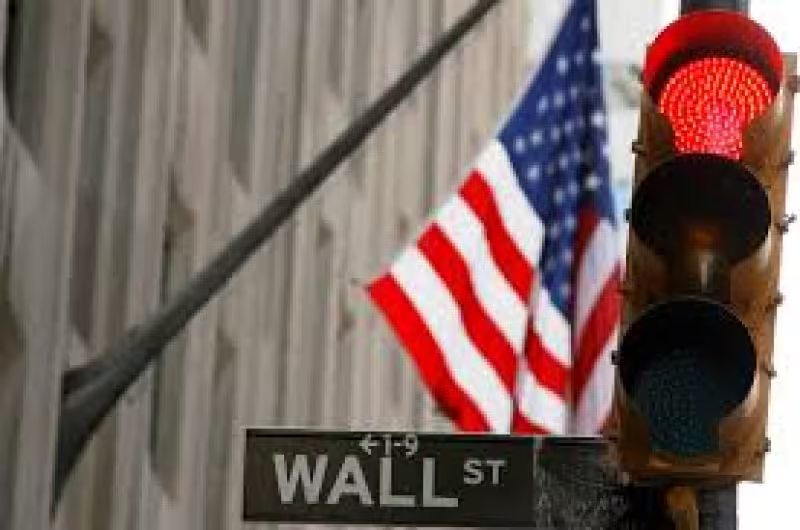
U.S. employers added 172,000 jobs in May, well above the roughly 88,000 economists expected, and the stronger reading sent the stock market lower early Friday as traders moved to fully price a quarter-point Federal Reserve rate hike by the December meeting.
The S&P 500 slipped 0.7% and the Nasdaq Composite sank 1.2% while the Dow Jones Industrial Average fell slightly. Tech and chip stocks led the sell-off after Broadcom’s earnings disappointed investors, amplifying losses in semiconductor names and undercutting the market’s push for what would have been a 10th straight winning week for the S&P 500 — the longest such streak since 1985 had the rally continued.

The jobs report showed the unemployment rate held at 4.3% for the third month running and average hourly earnings growth cooled to a 3.4% annual pace from 3.6% in the prior month. Those figures, alongside recent Personal Consumption Expenditures readings that show headline inflation rising 3.8% year-over-year and core PCE at 3.3%, helped lift yields on 10-year and 30-year Treasurys and reinforced market bets that the Fed may act before year-end. Oil prices ticked down as reports flagged stalled U.S.-Iran negotiations, a background factor that had been weighing on sentiment earlier in the week.
Traders’ reaction lays out the math plainly: payrolls well above expectations plus steady unemployment and still-elevated inflation metrics mean a higher-for-longer policy baseline. That shifted rate-implied probabilities sharply toward a one-quarter-point tightening by December, and the move in Treasury yields fed directly into share-price pressure, especially for growth and technology names sensitive to discount-rate changes.



Political pressure for easier policy sits at odds with that market calculus. President Donald Trump continued to call for cuts even as traders fully priced a December hike, underscoring a disconnect between political demands and market expectations about Federal Reserve action. Investors are left balancing those competing signals while parsing corporate earnings and economic data for clues about the central bank’s next move.
For portfolio managers and individual investors the immediate consequence is clear: expectations for tighter policy have become the market baseline, increasing volatility in rate-sensitive sectors and denting the recent advance. The S&P 500 had been seeking a rare 10th straight weekly gain; instead the stronger jobs print and disappointing Broadcom results curtailed that run and left tech shareholders more exposed.
Practical follow-ups are straightforward. The next confirmed policy reference point is the Fed’s December meeting, where traders are currently pricing a quarter-point move; until then markets will watch incoming data and corporate reports for evidence that would nudge the Fed toward or away from a hike. Readers who want a calendar check for market hours can see Is The Stock Market Open On Memorial Day — Markets Close Monday, May 25, 2026 ( and for how equities have been digesting geopolitical and oil moves see Stock Market News Today: S&P 500 Extends Win as U.S.-Iran Talks Ease Oil Pressure (
The single unanswered question now is whether the Federal Reserve will follow the market’s lead and raise rates by year-end; traders have priced that outcome, but the Fed’s decision will depend on the arc of inflation and jobs data between now and December.



