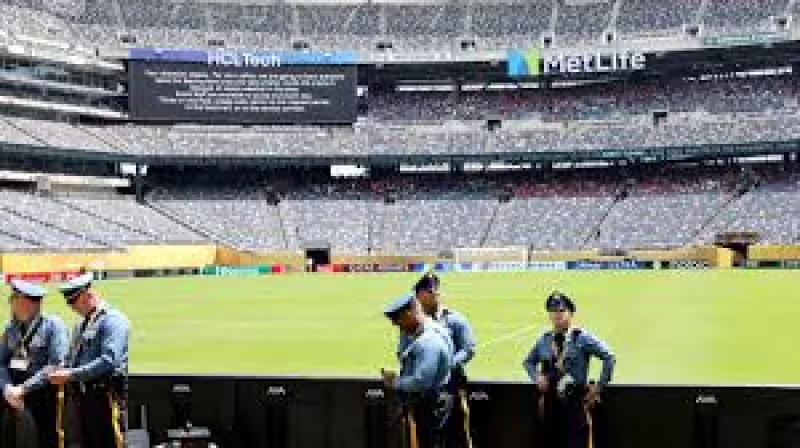
Starting Thursday, NRG Stadium will be placed under a full security lockdown as Houston finishes final preparations for the World Cup, city officials said.
The lockdown will tighten an enhanced perimeter around the stadium — which will be called Houston Stadium for the tournament — and include an 8-foot-high, concrete-reinforced anti-climb fence. Officials also announced fan screening locations and said drone operations are part of the plan as the city gets ready to host seven matches.

If you are asking where is the world cup 2026, Houston is one of the host cities: its first match is scheduled for June 14, and the city will stage seven games during the tournament. The lockdown comes a week before the global opener, a timing meant to give security teams a controlled window to deploy barriers, checkpoints and staff without game-day crowds in place.
The most visible element is the new fence, designed to push access points into managed screening zones. City planners said screening locations will funnel fans through controlled entries well before kickoffs. Those arrangements, officials said, are already being set and will remain in effect for the sequence of matches in Houston.
Houston Police Department Chief Noe Diaz confirmed that drone activity had been raised by city leadership and that the department has measures related to unmanned aircraft integrated into its plans. Diaz said the mayor had mentioned drone operations and that the police have the types of responses those scenarios require.
Beyond that confirmation, however, officials have stopped short of revealing operational specifics. While they say specialized training and equipment are in place to counter unmanned aerial threats, they have not disclosed what technology will be used, how many personnel will be assigned to drone monitoring, or how detection and interdiction tasks will be coordinated with federal or tournament security partners.
That gap — visible in brief public statements — is the most significant unresolved detail in Houston’s rollout. City and tournament authorities typically withhold tactical specifics to avoid tipping adversaries, but the lack of clarity leaves questions for fans and venue staff about what to expect in the airspace and how screening procedures will affect arrival times on match days.
Practical implications for spectators are straightforward: expect a hardened perimeter, fewer informal entry points, and formal screening areas that may require leaving more time to reach seats. The renaming of NRG Stadium to Houston Stadium means signage and wayfinding inside and outside the venue will reflect the temporary identity; transportation hubs feeding the stadium will operate under the new access patterns while the lockdown is in force.
What to watch next is simple and consequential. With the first Houston match set for June 14 and the city hosting seven matches in total, officials must publish at least operational basics — staffing levels, recommended arrival windows, and any temporary airspace restrictions — before fans begin to arrive in numbers. The headline action starts Thursday when the lockdown begins; the unanswered and necessary next step is a clear account of how drone security will be staffed and carried out around Houston Stadium during match days.