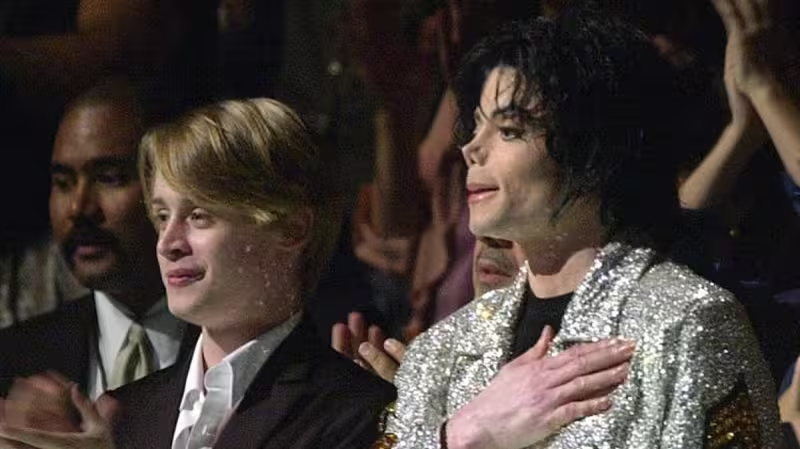
Netflix’s documentary Michael Jackson: The Verdict has resurfaced testimony from the 2005 criminal trial in which a Neverland ranch chef said Michael Jackson had his hand in Macaulay Culkin’s pants while the two were playing a video game. The allegation appears in the documentary as part of a wider retelling of staff testimony given during the prosecution’s case in 2005.
The claim in the film is traced to testimony by Phillip LeMarque, who, as the documentary recounts, said: "He testifies that Michael Jackson was playing the Thriller video game with the movie star Macaulay Culkin and Michael Jackson’s left hand was in the pants of the kid." LeMarque also told the court he did not go to police at the time because, in his words, "no one would have believed him."

Those passages have reappeared against a long public record of denials from Culkin. He went to court during the 2005 proceedings to state that Jackson had never been inappropriate with him, told Larry King in 2004 that "We played video games, nothing happened," and has repeated similar denials in later interviews, telling a podcast and Esquire that Jackson "never did anything to me" and that their relationship was a normal friendship.



Context for the revived allegation is entirely procedural: the documentary stitches together testimony from the original trial rather than presenting new eyewitness interviews on the point. Diane Diamond, who appears in the film, says staff were summoned to court by prosecutor Ron Zonen; Zonen himself at the time argued during proceedings that Jackson never had an adult guest in his room. The LeMarque claim is therefore one entry in a set of courtroom statements the film replays for viewers.
The record shown in the documentary contains other staff accounts that the prosecution offered in 2005. Security guard Ralph Chikhany is shown to have testified that he witnessed Jackson perform oral sex on another accuser, and maid Blanca Francia testified she saw Jackson in the shower with Wade Robson. Those separate testimonies underscore why the LeMarque passage drew attention, but they do not serve as direct corroboration of the Neverland chef’s statement about Culkin.
The friction at the center of this story is plain: a former employee described a specific physical act involving Jackson and Culkin while Culkin has consistently denied any inappropriate behavior. The trial record includes both positions—LeMarque’s recounting of what he said he saw and Culkin’s sworn denials—and the documentary frames both without adding new evidence that would resolve their contradiction.
There is no indication in the film or in public records that the revived coverage will prompt fresh legal action. The documentary’s effect so far is to reintroduce trial testimony to a new audience and to sharpen an unresolved factual split between witnesses and the man the chef named. Absent new corroboration or new witnesses willing to place events outside the court transcript, the conflict between LeMarque’s testimony and Culkin’s repeated denials remains the central unresolved question from the documentary.