



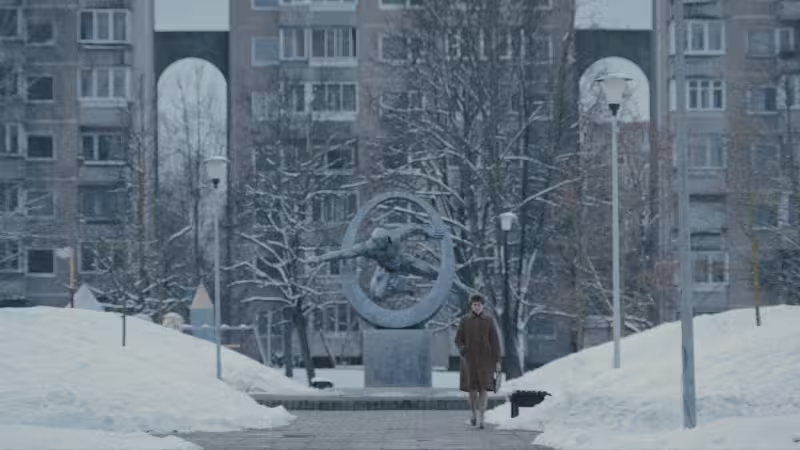
A review in calls Star City “the counterpoint/companion piece to For All Mankind,” and it delivers on that promise by shifting the alternate-history space race behind the iron curtain and turning spectacle into suspicion. The series stages a Soviet triumph — Alexei Leonov walking on the moon and delivering an oration about “the Marxist-Leninist way of life” — then uglily reframes victory as a prelude to interrogation, purges and shadowed power.
That tonal turn is the show’s chief argument. Star City refuses the glossy optimism that marked the early seasons of its parent and avoids the occasional soapiness that crept into later arcs; instead it leans into claustrophobia. singled out Lyudmilla — the head of KGB surveillance in the series — as “the terrifying Lyudmilla,” a figure who makes the triumph of a moonwalk feel immediately provisional. Acting choices and a pared-back production design push tension into every corridor and office, so that applause for the lunar conquest sits uneasily beside the clicking shut of interrogation rooms.

The series fills that unease with concrete people and decisions. A chief designer, played by Rhys Ifans, emerges after the landing, pressing President Brezhnev to bankroll grander projects — plans for Mars and Venus that, in the show’s logic, demand secrecy and ruthless discipline. On the ground, the show dramatizes how those demands play out: Yana is interrogated, removed from a coming lunar mission and replaced by Anastasia Belikova. Irina, who transcribes covert home recordings of cosmonauts and engineers, discovers that Yana was wrongfully accused and takes her findings to Lyudmilla. Those moves knit the state’s ideological rhetoric to a machinery of surveillance that quietly decides careers and lives.
Here is the decisive metric of Star City’s success: it makes the Cold War’s internal policing as narratively consequential as the race to plant a flag. The moonwalk and the speech are not merely milestones; they are the spectacle that masks the stakes of speaking, the risk of being suspected, the human cost of a secure national narrative. More than a hundred Germans are referenced in the series’ broader context, a reminder that the world the show portrays remains crowded with actors and agendas beyond the Kremlin’s immediate circle.



Context sharpens the meaning. For All Mankind is now in its fifth season and set for a sixth and final season, and the parent show’s alternate timeline is the stage on which Star City operates. By relocating the drama to the Soviet side, the spin-off undercuts any single-sided notion of progress: where one series gives you forward-looking engineering and political ambition, the other asks what it costs when every word must be weighed and every ally is a potential liability.
The friction is the point. Star City presents a state victory and then documents the paranoia that victory produces. The sequence that follows the lunar mission — the chief designer’s push for bolder programs, Yana’s interrogation, Irina’s discovery that Yana was wrongfully accused — exposes a gap the series treats as urgent: who, if anyone, will be blamed for leaks or failures, and how far will the apparatus go to secure an ideological future? The show implies that success can be used to justify control, and that control can hollow the meaning of success.
The unanswered question the series leaves ringing is both plot and politics: who leaked plans for a future moon base to the Americans, and how will that leak be resolved? Star City closes each episode by accelerating the hunt rather than closing it. If the show’s intent is to unsettle viewers about the moral shape of scientific ambition under authoritarian rule, it succeeds; if the intent is to deliver a mystery, it has positioned a traditional procedural — the search for a mole — inside a far more dangerous moral frame.
Star City’s value, then, is not merely that it’s a companion to For All Mankind; it is that it redraws the stakes. It replaces easy triumph with a question that will define the next episodes and, by extension, what viewers will demand from a modern space race drama: an answer about culpability, and a reckoning with the human cost of national prestige.



