



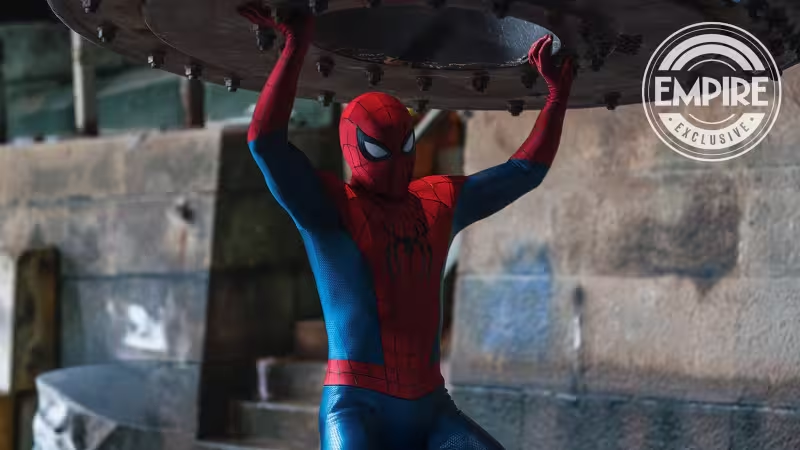
"It is the first Spider-Man film that we’ve made in the MCU that is focused on the classic elements of Spider-Man," Kevin Feige told reporters, spelling out a deliberate creative choice: this Spider-Man will be small in scale and lived-in in tone.
Feige did not couch the image. "He’s doing the Spidey thing of living in a rather sad, small apartment, listening to the police scanner and going out and using his great power responsibly," he said, a line that locates the movie in the quotidian details of New York life rather than in explosive set pieces.

The comments arrive as the film’s marketing appears to be preparing a fresh push: a second Spider-Man: Brand New Day trailer was age-rated PG in Alberta, Canada on May 28 and is listed at 2 minutes and 30 seconds, following the first trailer released March 18. The movie opens in cinemas from July 29 and arrives in theaters July 31.
Feige’s framing has been reinforced by the filmmakers. Director Destin Daniel Cretton summarized the production’s portrait of Parker plainly: "He is dedicating his entire existence to his job," he said, adding, "Screw it. I’m just going to work. I’m going to do nothing else but work." Producer Amy Pascal described Brand New Day as "a more internal movie, and the bigness of it is emotional, not worlds exploding."
The result, the creative team says, is a Tom Holland Peter Parker who has been cut off from his usual support: the film follows a version of Spider-Man operating as a fully fledged Friendly Neighbourhood Spider-Man while the world no longer remembers who he is, and Parker remains isolated from his friends and from Zendaya’s MJ.



Feige’s comments answer the clearest reader question about the film’s aim: he intends to foreground classic Spider-Man signifiers—the cramped apartment, the police scanner, the sense of personal duty—above the spectacle-driven rhythms that have defined some recent franchise entries.
That artistic decision creates an immediate marketing test. The first trailer left room for broader Marvel connections and sent fans speculating about possible crossings; whether the next slice of footage doubles down on close-up, day-to-day detail or leans back toward hints of larger entanglement will decide how audiences imagine this Spider-Man at scale.
The stakes are practical. If the new trailer follows Feige’s description, viewers should expect more emphasis on Parker’s loneliness and routine: the emotional bigness Amy Pascal mentioned. If it instead foregrounds the elements that prompted early fan theories, the studio will be signaling a hybrid approach—an inward story threaded into the wider Marvel apparatus.
For Tom Holland’s Peter Parker, the choice matters to the character’s arc. The filmmakers have framed him as someone who has turned his life over to the work itself; Cretton’s blunt phrasing—"He is dedicating his entire existence to his job"—makes clear the film’s psychological center is Peter’s commitment, not alliances or team-up spectacle.
Kevin Feige has placed the MCU’s bet publicly: Brand New Day is meant to fold Spider-Man back into neighborhood-level stakes and classic comic cues. The next public sign of whether marketing and the film itself will keep that promise is the second trailer; its Alberta rating on May 28 makes a release likely but does not fix a date. Two months after that first trailer, audiences will see the film when Spider-Man: Brand New Day reaches cinemas from July 29 and opens July 31.



