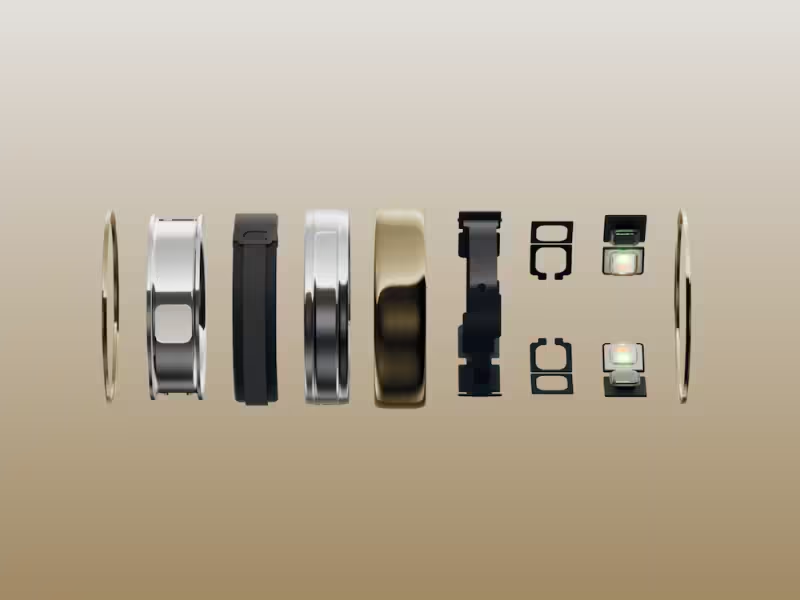
Oura introduced the Gen 5 Oura Ring on Tuesday as the company’s smallest smart ring yet, cutting volume by 40% compared with the Oura Ring 4 and trimming the band to about a 6 mm width.
Searches for gen 5 oura ring spiked because Oura pitched the change as more than cosmetic: a dramatically smaller form factor built to make constant wear easier while preserving—or improving—the health sensing users expect from a ring-shaped wearable.

The proof Oura offered is engineering, not just a slimmer silhouette. The company said teams rebuilt the ring "from the inside out," rearranging optical components and moving to precision-engineered, low-profile sensor domes that sit in a tighter package. Engineers rotated the LEDs 180 degrees to shorten optical paths for red, infrared and green light, and they fitted a larger photodiode component. That rework also created 12 stronger, more accurate signal pathways, a specific figure Oura highlights as central to the new design.
Oura tied the hardware work to a clear design decision. Mikko Aarras said the team settled on about 6 mm as the preferred width after research across a broad range of people, aiming for "the perfect size that people find comfortable and visually appealing." He added that going smaller felt too "dainty," a word the team used to explain why the new model stops where it does.
Tom Hale, whose title leads Oura’s product messaging, framed the change as functional: "We rebuilt Oura Ring from the inside out to deliver more accurate, continuous insights in a smaller, lighter, more comfortable ring—so people can focus on living their lives, not tracking them," he said. Oura also said the new finish is more durable than Ring 4, a detail aimed at users who wear the device around the clock.
On the sensing side, Oura said the Gen 5 Oura Ring is its most accurate generation ever made. J-T Mäkinen, part of the engineering group, described the trade-offs behind that claim: "The design balances signal strength and quality with the ability to drive LED chips with lower currents, meaning less power consumption." In plain terms, Oura says it reduced physical size while improving the optical and electrical path that turns light into heart-rate, temperature and sleep data.
That claim is the story’s friction point. A smaller, thinner ring gives designers fewer millimeters to place emitters, detectors and signal routes. Oura acknowledges that limitation but says the net effect of the redesign is parity with—or a slight improvement over—Ring 4’s performance. The company points to the larger photodiode, the 12 signal pathways and the rotated LEDs as the technical levers that offset the loss of space.
The consequence for users is simple: a lighter, less obtrusive device that, by Oura’s account, keeps pace with prior accuracy while using less power. Oura’s timeline shows the industrial design and optical sensing teams spent 2024–2025 building the Gen 5 architecture, but the company has not provided concrete launch details beyond the product reveal.
The clearest open question now is a practical one buyers need answered: when will the Gen 5 Oura Ring go on sale and at what price? Oura introduced the product and supplied technical claims and internal quotes, but it has not disclosed availability or cost. What matters next is whether the company can translate the smaller size and the 12-pathway sensing architecture into shipping units that match lab claims—and how much that capability will cost the people who want a less intrusive ring they can wear all day and night.