



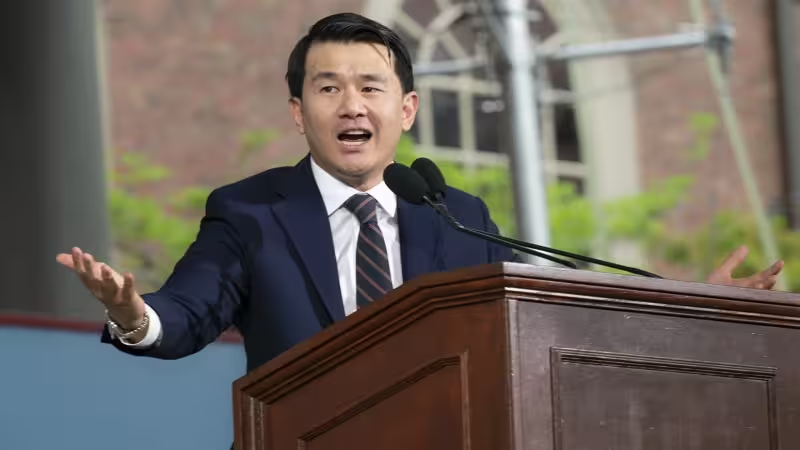
Ronny Chieng used his Harvard Class Day keynote Wednesday to tell the Class of 2026 to “destroy AI” — a profanity-laced plea that ended in a roar of approval from students and families at Tercentenary Theatre.
The comic’s line, “Can I just say f**k AI, f**k AI, f**k AI?” and his follow-up, “I’m here to tell you the mission of your generation is to destroy AI, kill it,” is the reason viewers are searching for ronny chieng today: the remarks cut straight into an inescapable commencement theme and landed where speeches usually aim — on a crowd’s strongest emotion.

Chieng framed the warning around work and joy. He told graduates not to let artificial intelligence “rob” them of the fun part of their chosen profession and insisted, “The creating is the fun part,” arguing that creativity remains a deeply human endeavor. He singled out the low-value uses of AI — reading and answering emails — as useless, and mocked the prospect of letting machines replace the messy business of learning and mastery.
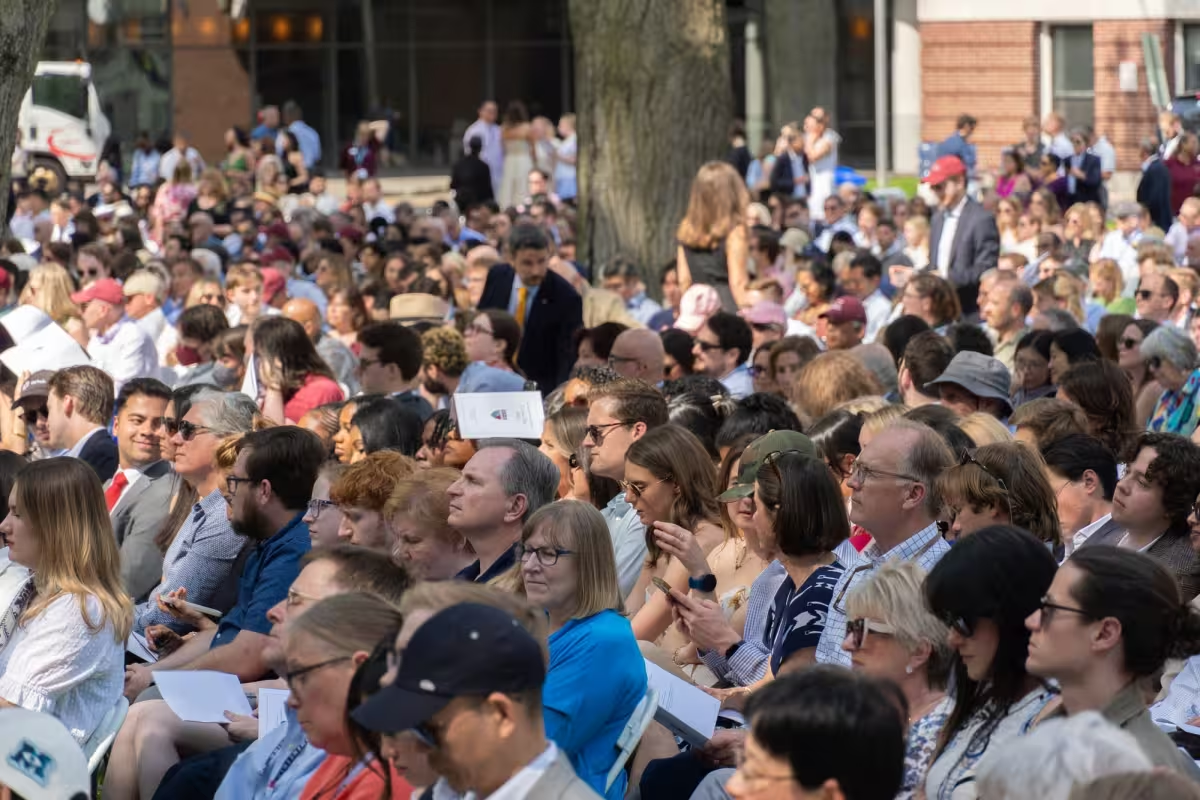
His rhetoric was blunt and public: the audience’s roar after his initial expletive was a clear measure of how visceral the moment felt to those on the lawn. Class Day, an annual celebration that includes student speeches and awards, drew seniors, friends and families to the theatre; Chieng’s remarks were part comic set, part cultural provocation and part direct counsel to a cohort about to decide how much of their lives and work to hand over to software.
But Chieng did not paint the technology with a single brush. He acknowledged that AI can serve research — he said it could be used to pioneer breakthroughs in medicine and physics — and made a carve-out for tools that accelerate discovery. “If you’re using it for that purpose, you’re not part of the problem,” he told the crowd, creating the central contradiction of his address: a call to destroy AI at the same time he allowed, even praised, narrow scientific uses.
Nicholas S. Kalkanis, who reflected on the speech afterward, said that was precisely the point Chieng was making through humor. Kalkanis highlighted the role of comedy in exposing life’s contradictions and absurdities — the way a single joke can make you see both the promise and the peril of a thing all at once. Chieng’s set pushed that duality hard: mockery and moral alarm on one hand, an admission that some machines perform work humans want done faster and better on the other.
Chieng tightened the argument with sharper distinctions. He warned of an upcoming battle between people with substance and those who fake mastery, between genuine taste and the tacky, framing the choice as moral and aesthetic as well as practical. He urged graduates to follow their passions and be transformative for others, and closed with a near-evangelical plea: “For the love of God, help me destroy these machines first.”
The speech did not stand alone in commencement week. Harvard’s president spoke about artificial intelligence in a Baccalaureate address the day before, and the MIT study “Your Brain on ChatGPT,” cited by campus publications, has warned that overreliance on language models can create cognitive debt. Those threads made Chieng’s blunt call feel less like a comedy bit and more like a civic provocation aimed at a generation whose career choices will shape how AI is used.
The friction is obvious and unresolved: Chieng both praises AI’s research-grade utility and demands its wholesale destruction as a cultural force. That tension landed as comedy at Tercentenary Theatre but it is a practical choice for graduates who will enter fields where employers can buy automation and where cultural authority can be outsourced to algorithms.
What happens next is the central unanswered question: will members of the Class of 2026 take Chieng’s counsel into their workplaces — refusing convenience in favor of craft — or will they adopt AI selectively, using it for breakthroughs in science while outsourcing routine cognitive chores? Chieng left them with a challenge more rhetorical than operational, and the decision about how to apply it will be settled one inbox, one script, one lab notebook at a time.



