



Jared Isaacman stood at a NASA briefing Tuesday as the agency announced three uncrewed missions to the moon later this year and revealed that Blue Origin—identified by NASA as Jeff Bezos’ company—had been awarded a contract to carry two science and technology payloads on its lunar lander.
The missions are formally named Moon Base 1, Moon Base 2 and Moon Base 3; Moon Base 1 is scheduled for no earlier than this fall. NASA said these flights are early steps toward constructing a permanent base on the lunar surface and that Moon Base 1 will be the first privately funded lunar lander mission in history, a point Isaacman underlined: "Moon Base 1 will be the first privately funded lunar lander mission in history." The agency said the lander awarded to Blue Origin will carry two science and technology payloads as part of that first flight.

The three missions have distinct payload plans. Astrobotic will transport more than 1,000 pounds of cargo and a moon rover on Moon Base 2. Moon Base 3 will study enigmatic lunar swirls and deliver payloads from the European Space Agency and South Korea’s space agency. NASA said the flights will scout locations at the moon’s south pole, gather scientific data, test technologies and prepare for the return of astronauts to the lunar surface.

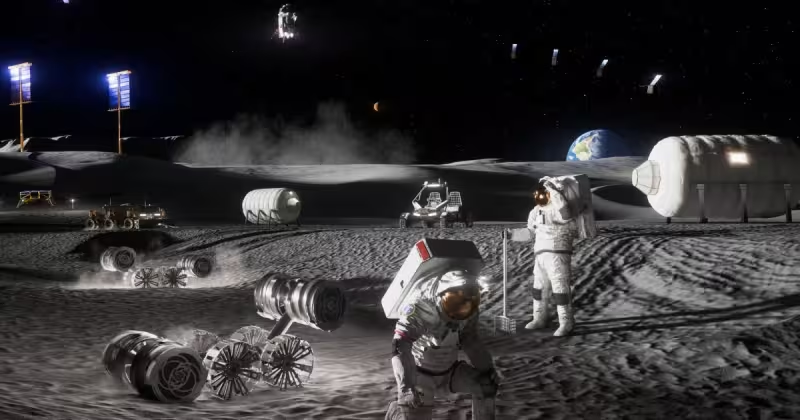
Those mission details are the opening chapter of a phased, multiyear plan. NASA officials described phase one as a build-up through 2029 that focuses on uncrewed landings and cargo deliveries. "Phase one, for example, will have 25 launches, 21 landings, and we’re planning to deliver about 4 metric tons of cargo to the surface of the moon," Carlos Garcia-Galan said, laying out the program’s numerical weight. Moon Base 1’s impending launch this fall starts a timeline that runs through phase two, from 2029 to 2032, when semipermanent facilities will be assembled, and on into phase three, starting in 2032, that aims for a sustained presence with regular rotations of crews coming and going.
Isaacman framed the work as deliberately incremental. "We are not jumping right into the glass dome moon base," he said, and he added: "We intend to take an iterative approach, sending a demand signal to industry for a lot of landers and rovers and tech demonstrations, and all the scientific payloads these missions can accommodate." He also tied the lunar effort to longer-term goals: the base will help NASA hone the skills needed to eventually venture to Mars, and "We’re talking about a $20 billion investment over the next seven years to establish that enduring presence on the moon."
The friction in the plan is its dependence on commercial partners to turn demand into deliveries. NASA has just announced that Blue Origin will fly early payloads, and Astrobotic will carry a heavy cargo load on Moon Base 2, but the agency’s numbers—25 launches, 21 landings and about 4 metric tons of delivered cargo in phase one—rest on an industry response that has yet to be tested at this scale. That gap between an ambitious schedule and private-sector capacity is the program’s central tension: NASA will be signaling demand and buying services while asking companies to build the vehicles and hardware fast enough to meet a tight timeline.
The immediate consequence is concrete: Moon Base 1 is now the milestone to watch. If the Blue Origin lander launches no earlier than this fall and performs as contracted, the program moves from planning to execution and gives industry a market signal to scale up. If it does not, the timetable for phase one—and the $20 billion push Isaacman described—will face its first major test. Either way, the simple answer to who owns Blue Origin matters because Jeff Bezos’ company now carries a real, early responsibility in NASA’s moon base plan.



