



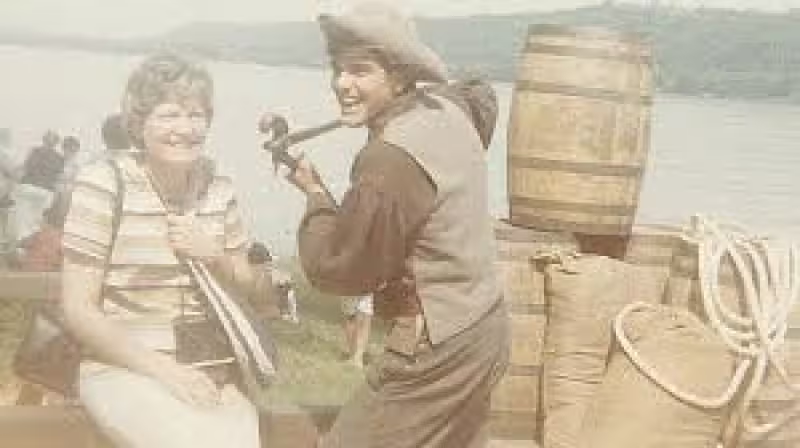
Perry Hibner has spent the last year tracing the origins of NBC's 1978 miniseries Centennial and, in the process, has reassembled what one local remembers as the moment a 17‑year‑old George Clooney first appeared on screen — briefly, as a young man carrying a barrel.
Hibner's work is not a footnote for cinephiles. The 26‑hour frontier saga cost an estimated $25 million and was the most expensive television production in history when it aired in 1978. It was filmed across Colorado, Wyoming, Ohio and Kentucky; Augusta, Kentucky doubled for St. Louis, and crews also worked in Lexington and Richmond. Hundreds of Kentucky residents were hired as background performers, paid $25 a day and offered one meal per person.

"It's my favorite show of all time," Hibner said, recalling why he kept returning to the story. "I read Michener's book when I was in sixth grade, all 1,100 pages. When the miniseries came out four years later, my family would gather around the TV on Sunday night to watch 'All in the Family' but I was in my bedroom watching 'Centennial.'"
Hibner began his search in 2025 after reading about fans traveling to Colorado to see locations from the series. He has conducted over 70 interviews and tracked roughly 100 locals who worked on the production, collecting memories of long days on set, the sight of star names and the tiny role that would later be tagged as George Clooney's first screen credit.

The cast of Centennial reads like a catalog of late‑20th‑century television names: Robert Conrad, Richard Chamberlain, Raymond Burr, Timothy Dalton, Barbara Carrera, Andy Griffith, Brian Keith, Lynn Redgrave, Stephanie Zimbalist and Mark Harmon. Against that roster, Clooney's single, uncredited appearance — carrying a barrel down a street — is small. Yet it is the official starting point of a career that would become notable precisely because it began in a production that was, by contemporary measures, enormous.
That contrast is part of what keeps Hibner digging. "I realized I wasn't the only person still interested in the miniseries, so I started reaching out to anyone I could find who had been involved in the production," he said. The friction is obvious: a production that spent $25 million and assembled a starry cast relied on local labor paid $25 a day and one meal, a gap Hibner's interviews keep highlighting.
Context helps explain why Centennial mattered then and why it matters now. James Michener published the bestseller Centennial in 1974; four years later NBC adapted it into a 26‑hour television event during the golden age of the American miniseries, grouped with titles such as Roots and The Thorn Birds. Clooney's brief appearance in 1978 marks the official start of his screen career inside that era of sprawling TV storytelling.
Hibner hears an additional lesson in the interviews: the production's cultural footprint goes beyond budgets and bylines. "I think it says a lot about 'Centennial' that Michener, who wrote more than 40 books, many of which were adapted for film and television, felt that NBC's 'Centennial' was the best representation of his work," Hibner said. Locals remember standing in background lines, eating the one provided meal, and later spotting their town doubled for a distant city on national television.
The most consequential fact Hibner's reporting surfaces is not that George Clooney once carried a barrel, but that blockbuster television depended on — and left lasting memories in — small communities that received little of the production's headline spending. Hibner's more than 70 interviews with roughly 100 locals make that conclusion plain: Centennial is both the launchpad for a major screen career and a reminder that the industry's grand gestures were built, in part, on the labor of ordinary people paid $25 a day.



