



House Republicans pulled a vote last week on a resolution aimed at limiting President Donald Trump’s war powers in Iran after GOP leaders appeared to lack the support needed to defeat the Democratic-led measure. The House has now postponed consideration until next month, even as the United States struck targets in Iran this week and a ceasefire remains in place amid talks.
The fight goes to the center of a law Congress passed in 1973 to curb unilateral military action. The War Powers Resolution says the president must notify lawmakers within 48 hours of sending U.S. forces into hostilities, limits unauthorized action to 60 days, and requires withdrawal if Congress does not approve the deployment, with a 30-day withdrawal period described in the Newsweek article. Trump did not seek congressional authorization before launching strikes on Iran on February 28 and informed Congress on March 2.

The politics inside Washington are just as sharp as the legal argument. Republicans hold the majority in both chambers, but Democrats have repeatedly tried to advance war powers resolutions aimed at limiting presidential military authority, and the issue has already forced awkward splits within the party in May, when the Senate voted for the first time to advance an Iran war powers resolution with support from four Republicans. Senators Lisa Murkowski, Susan Collins and Rand Paul backed a Democratic-led measure, and Sen. Bill Cassidy voted with Democrats to force the debate.
The House fight looked headed for the same kind of floor test before Republican leaders pulled it, and lawmakers left town after a vote that appeared destined to pass ran into attendance problems. Brian Mast, a Republican, said, “I don’t think the constitutionality of that has been tested,” adding, “I think it will probably be tested.” Another Republican, Michael McCaul, said, “They may challenge it right over there in the Supreme Court,” and noted that “every president since [Vietnam] has always at least verbally challenged the constitutionality of it.”
The White House is not hiding its view. Spokesperson Anna Kelly said, “Every administration has held that parts of the War Powers Resolution are unconstitutional since the law’s enactment in 1973,” and said Trump will continue to protect national security using his constitutional authority as commander-in-chief while being transparent with Congress. Cabinet officials and allies went further: Marco Rubio called the law unconstitutional, “100 percent”; JD Vance called it “fundamentally a fake and unconstitutional law”; Pete Hegseth said Trump has “all the authorities” necessary to restart operations in Iran without Congress. Lindsey Graham, meanwhile, urged Trump to ignore the statute and argued lawmakers should use the power of the purse instead, saying, “I’ve got no problem with any member of Congress trying to defund a military operation they think is bad,” but “I’ve got a ton of problems with 535 of us trying to be commander in chief every 60 days.”
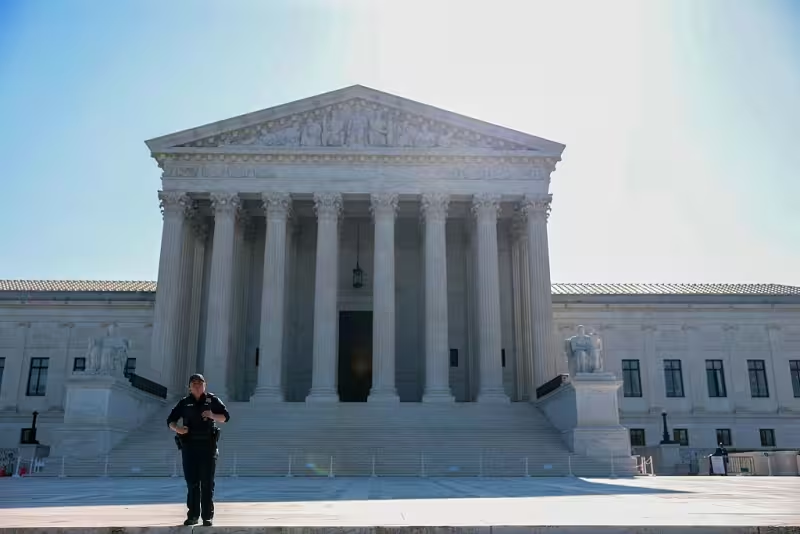
The deeper tension is that the War Powers Resolution has never really been settled in practice. Members of Congress have filed eight lawsuits seeking to force presidents to comply with it, according to the Congressional Research Service, but courts have largely sidestepped the merits by treating the disputes as political questions for the political branches to resolve. That leaves the issue where it has spent decades: in Congress, where lawmakers are divided over whether Trump needed authorization for Iran and where the next vote, scheduled for next month, could again expose the gap between what the law says and what presidents are willing to accept.



