

















Sam Antonacci’s Unassuming Approach, Hit-by-Pitch Habit and Rapid Rise Put White Sox Depth in Focus

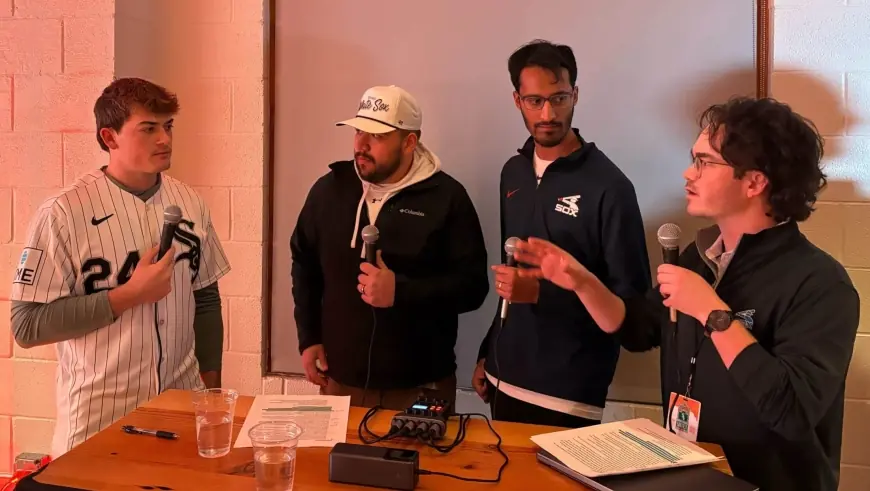
sam antonacci framed his game recently in straightforward terms: a contact-first, team-oriented hitter who prefers to contribute quietly rather than chase headlines. That self-description, offered during a public appearance at SoxFest Live, underscores a prospect profile defined by on-base skill, a willingness to take plates of contact — including frequent hit-by-pitches — and rapid advancement through the farm system.
What happened and what’s new
In an interview at SoxFest Live, Sam Antonacci recounted a development path that began after high school and included two years at junior college before moving up the ladder. He was a central figure on a national championship team at Heartland Community College and received recognition as the 2023 NJCAA Division II Player of the Year. Since entering the White Sox system, he climbed three levels in a single season, advancing from rookie ball to Double-A.
Antonacci also spent time in the Arizona Fall League, where he produced strong on-base results in limited at-bats and posted a notably high on-base percentage in that appearance. Last season he was hit by pitches at an unusually high rate, a pattern he described as part strategy and part coached emphasis on getting on base by any legal means. His recent professional season included more walks than strikeouts in total counts that were highlighted in a season summary made available before Spring Training. He received a non-roster invitation to major league camp and is slated to join Team Italy for the World Baseball Classic roster, where he will link up with a roster mate from his organization.
Behind the headline: context, incentives and stakeholders
Sam Antonacci’s rise is anchored in a nontraditional route and a development mindset focused on incremental improvement. After not being physically ready for Division I out of high school, he accepted the junior college route and used that environment to earn another opportunity at a higher level. Coaches at the collegiate level played a role in shaping his approach to plate discipline and to maintaining an aggressive stance in the batter’s box that sometimes results in being hit by pitches.
Key stakeholders include Antonacci himself, who benefits from continued playing time and exposure; the organization, which gains a versatile, on-base–oriented option for multiple infield positions; and Team Italy, which will use his skill set during international competition. Coaching staffs at both the professional and collegiate levels have leverage over mechanics and approach, which in turn affect assignment and playing-time decisions.
What we still don’t know
- Whether Antonacci will make the major league Opening Day roster or begin the season in the minors (unconfirmed).
- The long-term durability impact of repeatedly being hit by pitches and any resulting injury risk (unconfirmed).
- How the organization ultimately plans to deploy his defensive versatility — which position will become his primary big-league role (unconfirmed).
- The extent to which his Arizona Fall League performance will influence promotion timing or roster decisions (unconfirmed).
What happens next
- Minor-league start and WBC service: Antonacci begins the regular season in the minors and completes World Baseball Classic service with Team Italy; trigger — organizational choice to provide regular at-bats while preserving depth.
- Late-season call-up: continued on-base production and an in-season roster need lead to a major league call-up; trigger — sustained minor-league performance or an injury at the big-league level.
- Early roster bubble surprise: Antonacci earns an early-season bench role because his on-base profile fills an immediate need; trigger — strong showing in camp and pre-roster cuts plus team preference for contact/OBP options.
- Injury interruption: repeated contact from pitches leads to missed time, slowing momentum; trigger — an HBP-related injury or conservative management decision.
Why it matters
In the near term, Antonacci’s profile matters for roster construction. A player who gets on base reliably and can handle multiple infield spots increases organizational flexibility and creates matchup options for a big-league club weighing defense, offensive balance and depth. His willingness to accept physical risk to reach base highlights a trade-off the organization must manage between competitive benefit and player safety.
For fans and evaluators, the combination of a non-flashy self-assessment and measurable production reframes how to value prospects who arrive without top-five prospect fanfare but with clear on-field results. Internationally, his participation with Team Italy will provide additional at-bats against varied competition and a platform to further test his approach against a different sample of pitching.
Overall, the most immediate developments to watch are his assignments after Spring Training, any playing-time decisions tied to the World Baseball Classic, and how the organization balances his aggressive on-base strategy with injury prevention. Those outcomes will determine whether his steady climb translates into an impactful role at the major league level.