


















Nancy Guthrie ransom note: What’s known as deadlines pass and search intensifies

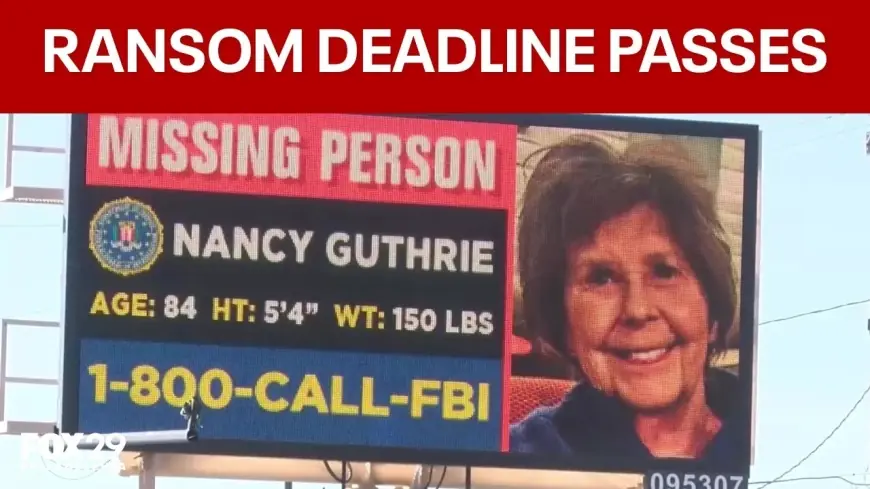
Investigators searching for 84-year-old Nancy Guthrie, the mother of television host Savannah Guthrie, are treating the case as a likely abduction while examining purported ransom communications that demanded multimillion-dollar payments in cryptocurrency. With no confirmed suspect publicly named and no publicly confirmed proof-of-life, authorities are urging the public to focus on practical, time-stamped tips—especially anything that helps identify a masked figure seen on the porch around the window of her disappearance.
Officials have emphasized that the existence of a ransom note does not, by itself, establish who took Guthrie or whether the sender has direct control over her whereabouts. That uncertainty is shaping both the investigation and the family’s public messaging as the search continues.
What the ransom note is said to demand
The most widely discussed letter laid out two escalating demands in bitcoin tied to specific deadlines: an initial demand of about $4 million due Thursday, Feb. 5, followed by a higher demand of about $6 million due Monday, Feb. 9. The communication was circulated to local media outlets rather than sent through a single, clearly verified channel to the family, a detail investigators have treated cautiously.
Authorities have not publicly authenticated the note as credible or connected to the abduction, and they have not confirmed any payment. In high-profile cases, investigators routinely receive opportunistic or hoax messages that exploit public fear and media attention.
Why investigators are cautious about authenticity
Even when a ransom message contains personal details, authorities typically test three questions before treating it as a true negotiation:
-
Does the sender demonstrate control over the victim’s location or condition?
-
Is there verifiable proof-of-life that can’t be faked from public information?
-
Do the demands, timing, and delivery method align with known behavior in real abductions?
In this case, officials have indicated they are still sorting what is real from what is noise. They have also stressed that there has not been publicly confirmed direct communication that establishes the sender’s identity or confirms Guthrie’s status.
The masked porch figure and the timeline pressure
Federal investigators have released surveillance images and video of a masked individual on or near Guthrie’s porch during the overnight window tied to her disappearance. Investigators have described the person as appearing armed and as taking actions that disabled or obstructed the home’s door camera. The images have become the central public-facing lead because they give the public something concrete to recognize—clothing, a backpack, posture, and movement.
Authorities have said Guthrie was last known to be at home Friday, Jan. 31, and was reported missing Saturday, Feb. 1, after she did not arrive for a routine church service and could not be reached. Investigators have also said blood found on the porch was matched to Guthrie through DNA testing, supporting the conclusion she was taken against her will.
That combination—evidence at the scene, a narrowed time window, and an identifiable figure—helps explain why the investigation has pushed so hard for neighborhood and business surveillance footage from late Jan. 31 into early Feb. 1.
What families are often told about ransom demands
In cases where a ransom message surfaces without verified proof-of-life, families are commonly advised to avoid acting on pressure deadlines and to route all contact through law enforcement. The goal is to prevent payments to hoaxers and to avoid escalating risk to the victim if a real abductor is involved.
Authorities also often encourage families to preserve every message, envelope, screenshot, or electronic trace tied to any demand. Even a fraudulent note can leave digital and physical evidence—printing artifacts, metadata, routing information, or patterns in the sender’s language—that can generate investigative leads.
What typically happens next
As the ransom-note storyline collides with a still-open missing-person search, investigators usually move on parallel tracks:
-
Forensic review of the communication itself, including how it was delivered
-
Expanded video mapping to determine whether the masked porch figure arrived by foot or vehicle and where they went next
-
Tip triage as public awareness increases, prioritizing time-stamped sightings and original, unedited footage
-
Targeted warrant activity once a tighter movement timeline is established
Officials have continued to emphasize that there is no confirmed suspect or person of interest publicly named at this stage, despite the release of the porch images. That distinction signals the case remains in an identification phase, where the most valuable public help is recognition and corroboration.
What the public can do that helps right now
The most useful tips tend to be specific and verifiable: exterior camera clips from the overnight window, sightings with an exact time and location, or recognition of distinctive gear shown in the released images. Investigators have urged residents and businesses to preserve footage quickly because many systems overwrite video within days.
For anyone who believes they recognize the masked figure, authorities generally want the “why” (where you’ve seen the person, what stands out) and any supporting context (vehicles, addresses, names, dates).
Sources consulted: Associated Press, ABC News, CBS News, Los Angeles Times