

























Punxsutawney Phil sees his shadow in 2026, calling for 6 more weeks of winter

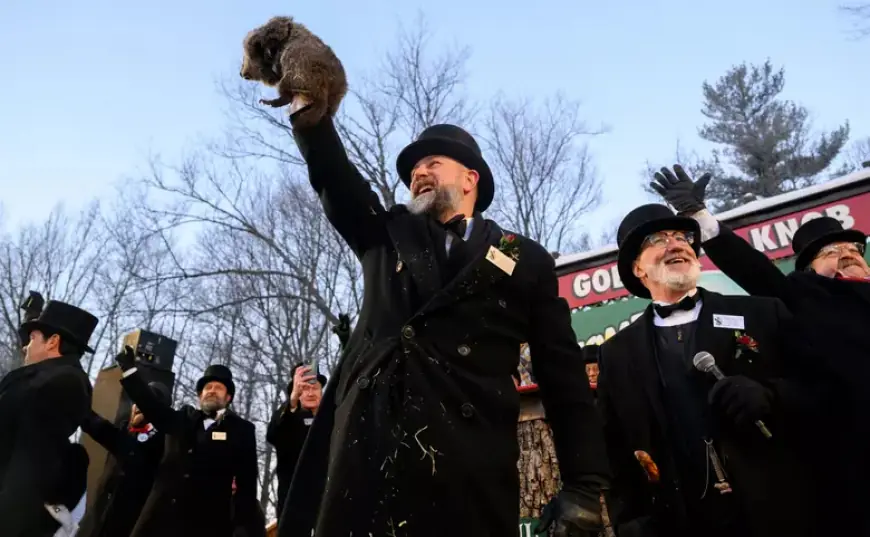
Punxsutawney Phil saw his shadow on Groundhog Day 2026, delivering the tradition’s familiar forecast: six more weeks of winter. The pre-dawn ceremony in Punxsutawney, Pennsylvania drew tens of thousands of visitors to Gobbler’s Knob on Monday, February 2, 2026 (ET), as Phil was lifted from his burrow near sunrise and the verdict was read to the crowd.
The result quickly rippled beyond western Pennsylvania, where other well-known “forecasting” groundhogs and local ceremonies offered a mix of agreement and dissent—fueling the annual wave of questions about what Phil “said,” what the shadow means, and how the ritual actually works.
Punxsutawney Phil 2026: shadow result
Phil’s call was straightforward: shadow seen, winter stays longer. In the tradition’s script, the groundhog doesn’t speak directly; a handler reads an “interpretation” of Phil’s decision to the crowd. The practical translation for 2026 is the same phrase heard most years: six more weeks of winter conditions rather than an early spring.
The ceremony took place around sunrise in Punxsutawney, which falls in the Eastern Time Zone, and the result was announced shortly after Phil emerged. Festivities begin hours earlier—well before daylight—so visitors arriving at Gobbler’s Knob often do so in the middle of the night.
Did other groundhogs agree this year?
Several prominent local groundhogs aligned with Phil’s 2026 call, while at least one high-profile midwestern ceremony diverged. Here’s how a few of the better-known predictions lined up:
| Groundhog (location) | Shadow? | 2026 call |
|---|---|---|
| Punxsutawney Phil (Pennsylvania) | Yes | 6 more weeks of winter |
| Staten Island Chuck (New York) | Yes | 6 more weeks of winter |
| General Beauregard “Beau” Lee (Georgia) | Yes | 6 more weeks of winter |
| Woodstock Willie (Illinois) | No | Early spring |
These outcomes reflect the long-running reality of Groundhog Day: there is no single national “result,” just a headline-maker in Punxsutawney and a patchwork of local traditions that sometimes agree and sometimes do not.
What it means if the groundhog sees his shadow
The meaning is simple and symbolic, not scientific. If the groundhog sees its shadow, the folklore says it retreats to its burrow and winter will linger for six more weeks. If it does not see its shadow, it supposedly stays out and an early spring is on the way.
The tradition’s timing is anchored to the calendar rather than weather conditions: Groundhog Day is always February 2. It is not a federal holiday, though many towns treat it as a major annual event with parades, live coverage, and school or civic tie-ins.
What time does Phil come out?
Groundhog Day festivities in Punxsutawney typically start around 3:00 a.m. (ET) with music, speeches, and crowd build-up. Phil’s emergence is tied to sunrise, which varies year to year but generally lands shortly after 7:00 a.m. (ET) in early February.
For people searching “Groundhog Day live stream” or “where to watch,” the consistent rule is this: the action happens at dawn, not later in the morning. Local ceremonies elsewhere often schedule their own “reveal” slightly later.
How accurate is Punxsutawney Phil?
Phil’s “accuracy” is best understood as a cultural talking point rather than a meteorological score. Groundhog Day predictions do not follow the same standards as seasonal outlooks, and the definitions of “early spring” versus “six more weeks of winter” are not consistently measured across regions.
Even so, weather agencies and researchers frequently note that the tradition does not outperform chance in a strict sense. It remains popular because it marks the midpoint of winter in a fun, repeatable way—and because it invites everyone to debate what counts as “spring” in the first place.
What to watch next in 2026
Phil’s shadow call arrives as winter weather remains highly regional: one city may be thawing while another is bracing for snow and ice. The next six weeks—through mid-March—will be shaped less by folklore and more by storm tracks, temperature swings, and late-season cold snaps.
For practical planning, the most useful takeaway from Groundhog Day is the calendar reminder: early February is still deep winter, and meaningful warm-ups can be interrupted by sudden cold returns. If you’re making travel or outdoor plans for late February and early March, keeping flexibility matters more than any single ceremonial prediction.
Sources consulted: Associated Press, Reuters, ABC News, National Weather Service