

























Artemis II launch date: NASA targets early February 2026 for first crewed Orion mission around the Moon

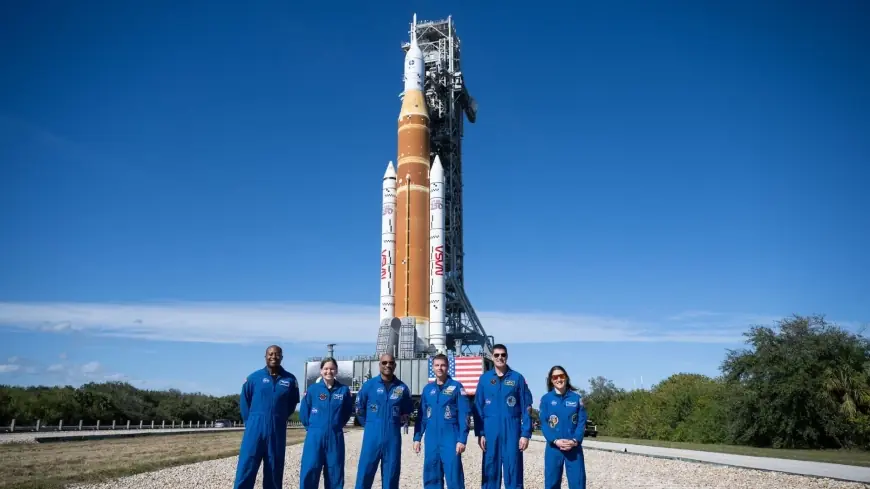
NASA’s Artemis II launch date is moving into sharper focus, with the agency now working toward a liftoff window that opens February 6, 2026 from Kennedy Space Center in Florida. While “February 6” is widely circulating as the headline target, the mission team still has a major readiness checkpoint ahead, meaning the final call on an exact date and time will come only after critical pad tests are completed.
Artemis II is the first crewed flight of NASA’s Space Launch System (SLS) rocket and Orion spacecraft, sending four astronauts on a roughly 10-day mission that loops around the Moon and returns to Earth. It is designed to validate systems and operations in deep space before later Artemis missions attempt a lunar landing.
Artemis II launch date: the current window and backup opportunities
The current planning centers on a primary February 6–11, 2026 window. NASA has also identified two backup periods—one in March and another in early April—based on orbital geometry, recovery conditions, and mission design constraints.
Here are the launch opportunities currently on the table:
-
Primary window: February 6–11, 2026
-
Backup window 1: March 3–11, 2026
-
Backup window 2: April 1–6, 2026
Even within a “window,” daily launch opportunities are limited to specific hours. The opening opportunity is scheduled for February 6 at 9:41 PM Eastern Time, with a window lasting about two hours. Times can shift as teams refine the trajectory and align ground operations.
Why the Artemis II launch date is still “no earlier than” February 6
Spaceflight calendars often use “no earlier than” language because the schedule depends on passing a chain of technical milestones. For Artemis II, a key hurdle is the wet dress rehearsal—a full practice countdown that includes loading propellants and running the launch sequence in conditions that closely mirror launch day.
This rehearsal is designed to expose last-minute issues with:
-
Ground systems and countdown procedures
-
Propellant loading and temperature management
-
Hardware, software, and communications timing
-
Coordination between launch controllers, flight operations, and the crew
A clean rehearsal supports staying in the earliest part of the February window. Any anomalies could require additional troubleshooting, schedule reshuffling, or even a rollback of the rocket to the Vehicle Assembly Building for work—one reason NASA keeps March and April opportunities ready.
Artemis II rocket at the pad: what changed in January 2026
Momentum has picked up in recent days as the SLS rocket and Orion spacecraft completed a major milestone: the integrated vehicle rolled out to Launch Complex 39B at Kennedy Space Center. The move to the pad is a visible step, but it is also a practical one—many of the most important prelaunch tests must happen at the pad, with the rocket connected to the mobile launcher and launch infrastructure.
With Artemis II now in the pad flow, teams enter the phase where schedules become both more concrete and more sensitive. Once a rocket is at the pad, weather, range availability, and the timing of other nearby missions can also influence day-by-day planning.
Who’s flying Artemis II and what the mission will do
Artemis II’s crew brings NASA and international participation together for the program’s first human flight beyond low Earth orbit in more than five decades:
-
Reid Wiseman (commander)
-
Victor Glover (pilot)
-
Christina Koch (mission specialist)
-
Jeremy Hansen (mission specialist, Canadian Space Agency)
The mission will send Orion on a lunar flyby trajectory that swings around the Moon and returns to Earth. Artemis II is not a landing attempt; instead, it is a deep-space systems test with humans aboard—life support performance, navigation, communications, crew operations, and the spacecraft’s heat shield and reentry profile.
What “launch window” means for people tracking Artemis II
If you’re watching for an exact Artemis II launch date, it helps to think in layers:
-
Monthly window (February, March, April options)
-
Daily opportunity (only certain days inside each window)
-
Hourly window (a limited number of hours on a given day)
That structure is driven by the Moon’s position, lighting and thermal constraints, and recovery planning. A slip of a day or two doesn’t necessarily mean something went wrong; it can simply reflect the narrow geometry needed to execute the mission and bring Orion home safely.
Quick time guide for the opening opportunity
The first planned opportunity is February 6, 2026 at 9:41 PM ET. Here’s a simple conversion for international tracking:
| Location | Time |
|---|---|
| Florida / US Eastern (ET) | Feb 6, 9:41 PM |
| US Pacific (PT) | Feb 6, 6:41 PM |
| UK (GMT) | Feb 7, 2:41 AM |
| Egypt (Cairo, EET) | Feb 7, 4:41 AM |
Times remain subject to change as launch readiness is confirmed.
What to watch next as the Artemis II launch date approaches
The next major schedule-shaping moment is the wet dress rehearsal and NASA’s subsequent readiness review. Those events will determine whether the mission stays near the front of the February window or shifts deeper into the window—or into March or April.
For now, the headline remains: Artemis II is targeting a launch window opening February 6, 2026, with built-in backup windows in March and April if needed, as NASA lines up the final tests for the first crewed Moon flyby of the Artemis era.