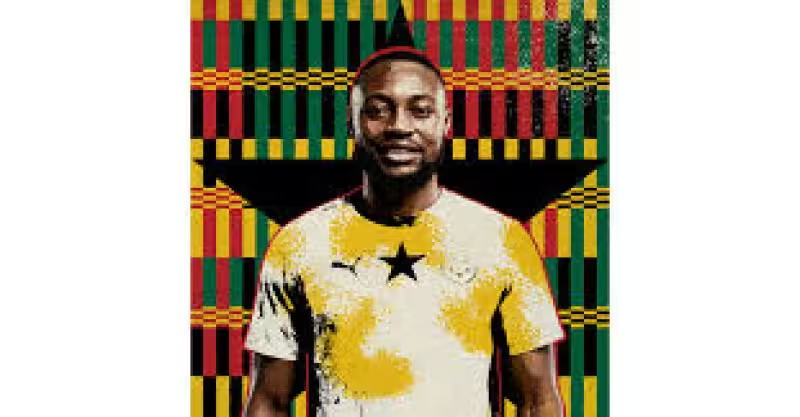
Antoine Semenyo unveiled a digital artwork in Toronto on the opening of Ghana's World Cup 2026 campaign, presenting a visual that blends traditional Kente patterns with AFCON street culture to represent West African identity on the tournament stage.
The piece, billed as part of the Ghana Black Stars X Semenyo World Cup 2026 project, was described by organizers as a move to bring West African identity to the world stage. The work merges the bright geometric weaves of Kente cloth with motifs drawn from AFCON street culture, creating a public-facing image intended to link Ghana’s football campaign with its wider cultural heritage.

The event in Toronto marked the campaign's kickoff. The project listing included Matthew Green with Telos Advisory among its named participants, signaling a professional advisory structure behind the launch. Organizers framed the artwork as campaign material for the Ghana Black Stars ahead of World Cup 2026, positioning Semenyo’s unveiling as a cultural moment tied to the national team’s global push.
For fans and followers of Semenyo, the artwork provides a clear symbolic line: a leading Ghana international using his platform to foreground Ghanaian and West African visual traditions as the nation prepares for the World Cup. The combination of Kente and AFCON street aesthetics aims to translate local cultural textures into a language that international audiences will see alongside match coverage and promotional material.
But the presentation leaves a notable gap between symbolism and sport. The project produces a heritage‑focused image for a World Cup campaign, yet it does not explain how the digital artwork will connect to on‑field outcomes or competitive dynamics. There is no detail on whether the artwork will accompany team kits, stadium graphics, broadcast packages, or community initiatives that could produce measurable effects for the Black Stars during the tournament.
Equally unclear is what role Semenyo will play beyond unveiling the artwork. The listing connects his name to the campaign, and the Toronto event served as a public kickoff, but the project materials do not specify whether he is acting as a creative collaborator, an official campaign ambassador, or simply a figurehead for a single launch event. That distinction matters to supporters who want to know whether Semenyo’s involvement will translate into sustained engagement with fans or into activities that could influence team morale or visibility during World Cup 2026.
The timing — a campaign launch in Toronto tied to the World Cup 2026 cycle — does make the artwork a timely cultural declaration. Framing the launch in a major, international city gives the project an immediate audience outside Ghana and West Africa, which aligns with the stated aim of taking West African identity to a global stage. Yet without follow-up details, the campaign currently reads as a high‑visibility statement rather than a programme with clear outputs linked to matches or tournament logistics.
What comes next will decide whether the artwork becomes a lasting part of Ghana’s World Cup presence or remains a stand‑alone cultural moment. The organizers have so far only confirmed the Toronto kickoff and the Ghana Black Stars association; no further public events or Semenyo commitments tied directly to on‑field activities have been announced. Observers should watch for concrete steps — promotional scheduling, integration into team materials, or community projects — that would turn the visual into an operational element of the World Cup campaign.
For now, the artwork is a deliberate assertion of identity: a player‑led image that aims to carry Kente and AFCON street culture into the visual vocabulary of World Cup 2026. Whether that assertion influences outcomes on the pitch will depend on the next moves by the campaign’s organizers and by Semenyo himself, whose next public role in the project has not been specified.