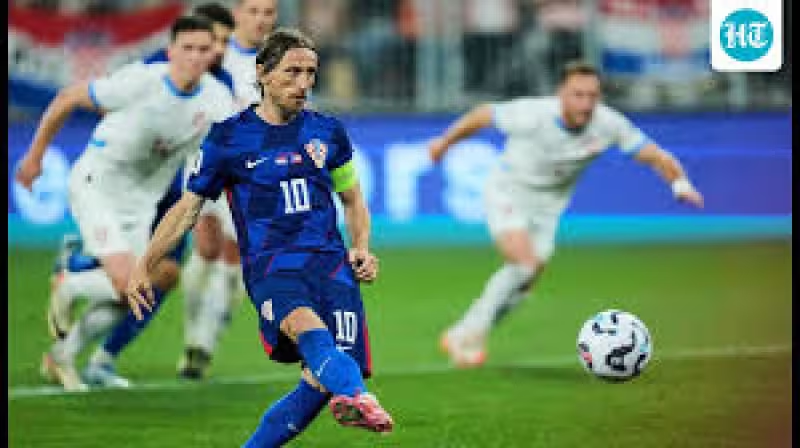
Igor Stimac publicly named Martin Baturina the player who will one day step into Luka Modric’s shoes for Croatia, saying: "They have brought strength and ability to the team. Baturina comes off a good second half of the season with Como. We are convinced that once Luka is done, Baturina will be the one to put his feet into Luka’s big boots."
The endorsement is plain and consequential: Stimac picked two specific younger midfielders—23-year-old Baturina and 22-year-old Petar Susic—to carry Croatia’s midfield forward as the veterans recede. Baturina, an attacking midfielder born in Switzerland, was singled out for recent form at Como; Susic, who plays for Inter Milan, was held up as a direct replacement for Marcelo Brozovic, who has retired from international football.

Stimac laid out the functional case for both players in blunt terms. On Susic he said: "He is similar to Brozovic, maybe even higher quality and this is saying a lot. He’s very creative and dangerous coming into the box. He can cover the pitch in the same way Brozovic did, running 16-17km per game." For Baturina, the point was developmental—come good at club level and you inherit the midfield keys.
That endorsement is being made now because Croatia are about to open their Group L campaign in Dallas on Wednesday against England. Stimac’s selections frame the conversation about minutes and roles that will be decided on the pitch there: who helps Modric now, who replaces the retired Brozovic, and who is being groomed to take the torch once Modric departs.
Context sharpens the moment. Stimac warned the squad is not at full strength: "we are not in our best moment." He also noted Modric, Josko Gvardiol and Mateo Kovacic are arriving after long injury breaks. Modric’s own season ended in April after a cheekbone fracture that needed surgery, and Stimac acknowledged those limits while still privileging Modric’s presence: "Modric should start because of how important he is to the team." Minutes management follows: "But I am not there talking to him to see how he feels and whether it is personally better for him to play the last 30 minutes. Luka is very reasonable. He will start on the bench for the sake of the team."
Stimac compared the concept of shared responsibility to another famous national setup, saying Baturina and Susic "can help Modric in the way Rodrigo de Paul and Julian Alvarez covered for Messi in Qatar." The analogy frames a dual solution—two runners and creators supporting an aging genius rather than a single heir apparent shouldering everything immediately.
The friction in Stimac’s argument is immediate and unavoidable. He praises Croatia’s depth—"They have brought strength and ability to the team"—while conceding the core veterans are fragile and the squad "not in our best moment." Naming successors is a projection; reality will be measured in minutes, match situations and recovery from injury. Susic’s capacity to match Brozovic’s distance is quantifiable on the tracking charts, but whether Baturina can become the defining midfield presence after Modric remains unproven at the international level.
There is an immediate test. Croatia open against England in Dallas on Wednesday, and Ghana, managed by Carlos Queiroz, loom as a difficult opponent later in the group. Stimac’s public selection has turned those early minutes into more than preparation: they are the first chapter in a planned transition. If Baturina plays the role Stimac describes—linking play, arriving in the box, showing the stamina and creativity the coach expects—the claim will gain weight. If he does not, the question of who ultimately fills Modric’s big boots will stay very much open.