



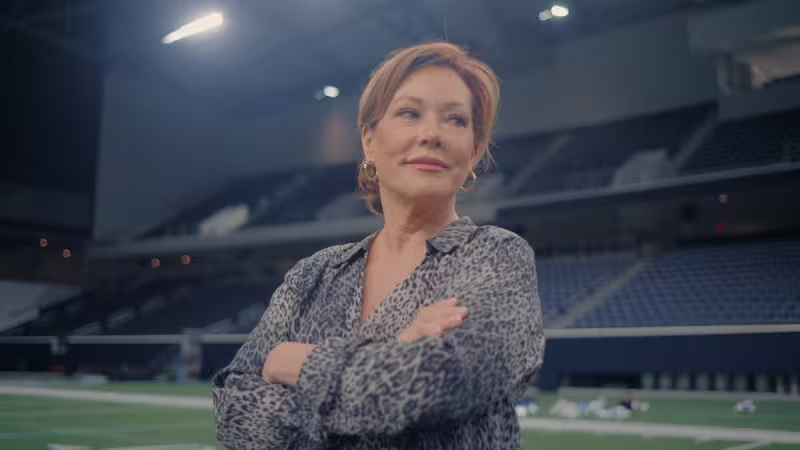
"I was sad the day she told us," Kelli Finglass said, describing her reaction when Reece Weaver announced she was stepping away from the Dallas Cowboys Cheerleaders after three seasons. Finglass added that Weaver was newly married and had returned to Alabama, and that the decision made sense for the dancer who, in her words, had a full career in that span.
The moment landed in public this week because Season 3 of America's Sweethearts: Dallas Cowboys Cheerleaders arrived on Netflix June 16, tracing the 2025-26 squad from auditions and training camp through the NFL season. The series shows Weaver’s final year on the roster — an arc that includes an injury that forced her to miss several games and, ultimately, her retirement from the team.

Finglass framed Weaver's departure not as a loss for the organization but as an understandable close to a short, intense run. "Not necessarily. Three years is a really full career. It really is," Finglass said. "Reece, to use her words, her cup was full. She's had a lot of experiences in her three years here, and she's been such a positive light for us. I was sad the day she told us, but it made perfect sense." She called Weaver "one of the darlings in the Dallas Cowboys Cheerleaders" and said the team and its fan base would miss her.
The series underlines the roster math behind Finglass’s comments. Training camp typically begins with 45 women, Finglass said, and the squad is trimmed to 36 for the season. That structure, she said, is part of why she resists elevating a single dancer into the role of team 'face.' "Honestly, I've never thought of one single cheerleader like that," she said.
That stance creates a small friction between the show's storytelling and team leadership. Netflix's cameras and fan attention single out personalities — Weaver clearly emerged as a viewer favorite — while Finglass insists the organization functions as a collective. The show also highlights operational pressures: injuries, social media scrutiny and the lack of a formal backup roster, which has forced the team to rely on former members when appearances and absences overlap.
Finglass said the organization leans on its All-Star alumni when the appearance load gets heavy or an injury leaves a gap, and that the team has reached back to past members in similar situations before. The current roster, she said, is centered around all 36 women, not a single standout, and the DCC maintains All-Stars who can step in for appearances.
Season 3 presents other roster drama that frames Weaver’s exit as part of a larger turnover: Dayton Bramhall was cut for the third time in the season, and Faith Ward became the first-ever New Zealander to make the squad. Those moves, shown on the series, illustrate how fluid the group can be from one season to the next.
Finglass also used the new season to celebrate the ensemble’s achievements. "I love this year that we get to showcase our stage show. That's a dream come true. We really get to celebrate how talented they are. I'm really proud of this year, and of course, the ladies who made the team," she said, signaling that the organization intends to keep its focus on group production as Weaver departs.
The practical question left by Weaver’s retirement is obvious and unresolved: if viewers and fans have latched onto individual personalities, who will emerge as the most visible presence now that one of the squad’s darlings has left? Finglass’s answer — that she has never believed in a single face and that the team is built on 36 women supported by All-Stars — settles the organization’s posture but not the audience’s appetite for a new favorite.



