



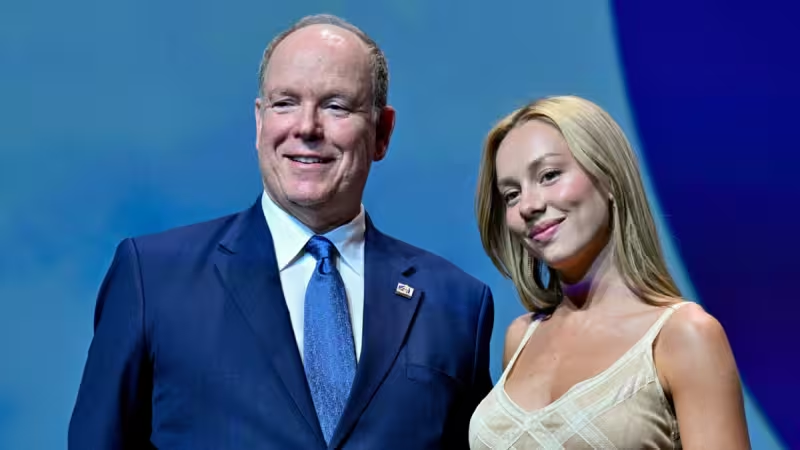
Ester Expósito arrived at the Grimaldi Forum on June 12 to accept the International Golden Nymph award and left insisting the brief, awkward clip that trended afterward was nothing more than "Lo que pasó ahí fue una tontería." The 26-year-old actress received the prize amid applause but also a small, widely shared moment of uncertainty while meeting Prince Albert of Monaco that dominated social feeds by evening.
The award—Best International Promising Talent—was presented by Prince Albert during the opening ceremony of the 65th Monte Carlo Television Festival, the long-running festival created by Rainier III in 1961 and held under the High Patronage of Prince Albert II. Expósito joined honorees Kristin Scott Thomas and Kurt Russell at the event, which runs from June 12 to June 16 and staged its gala at the Grimaldi Forum.

The most tangible sign of the evening was the trophy itself: the International Golden Nymph, handed to Expósito in front of an industry audience and cameras. That formal moment is the point—the prize is a marker of her rising international profile beyond Spain, an acknowledgement of the career trajectory that began to widen after her breakout on Élite and now has her recognized on a festival platform with global visibility.
There is texture to the image the cameras caught. Expósito wore an archive Teresa Helbig design from the Autumn-Winter 2017/2018 collection, a layered ivory tulle dress with geometric embroidery that photographers noted as both classic and theatrical on the Monte Carlo stage. She attended without her partner Kylian Mbappé, who was with the French national team preparing for the World Cup; France is scheduled to debut on June 16 at MetLife Stadium against Senegal.



The friction in the story is small and public: a short video clip circulated showing Expósito greeting Prince Albert, then pausing with an expression that viewers interpreted variously as surprise, confusion or simple unfamiliarity with ceremonial protocol. The footage is under ten seconds; it prompted a wave of commentary about etiquette and celebrity composure. Expósito herself downplayed the attention, calling it a nonsense moment in Spanish and refusing to let the exchange eclipse the award.
That reaction — a high-profile recognition shadowed by an ordinary social-media hiccup — says something about how moments are read now. The ceremony at the Grimaldi Forum was structured, staged and documented; within hours a fragment of human uncertainty became the headline for many online outlets. Yet the award remains: an industry distinction that places Expósito among emerging international talents and beside established figures honored at this edition of the festival.
For Expósito, the immediate consequence is practical and predictable: she leaves Monte Carlo with a Golden Nymph and a media moment that will likely be footnoted to the honor. The festival continues through June 16, culminating with the Ninfa de Oro awards, and the schedule gives her further public appearances to reinforce the narrative the industry prize is meant to signal — professional recognition more than a viral anecdote.
If the only question is what the clip changed, the answer is narrow: it redirected some attention for a day but did not alter the ceremony's outcome or the mechanics of the prize. Expósito received the International Golden Nymph, posed in Teresa Helbig, and described the episode as trivial; the festival presses on toward its closing awards on June 16, and the conversation about protocol will likely settle back into the larger story the trophy confirms—her growing presence on the international screen. For readers wanting more on the intersection of her public life and the World Cup headlines tied to Mbappé's schedule, see



