



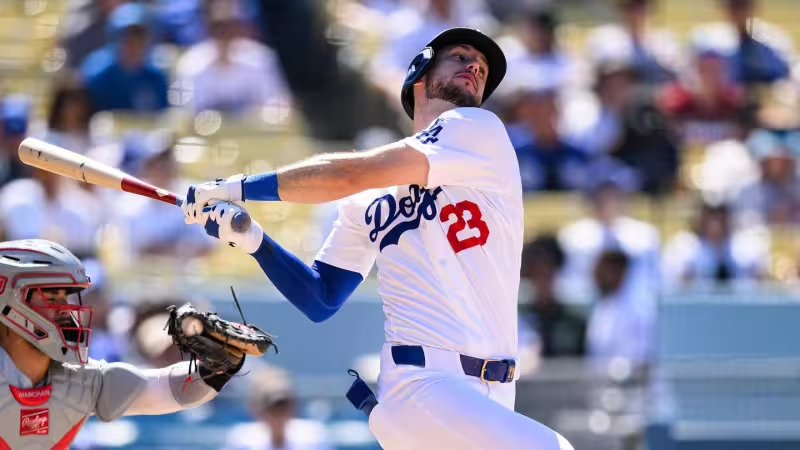
Kyle Tucker’s performance this season has made it unlikely he will opt out of his contract, and the Los Angeles Dodgers are now preparing as if he will remain on the roster for three more years beyond this one.
Tucker has a 110 wRC+ this season and, among Dodgers with at least 200 plate appearances, owns the lowest wRC+. That marks a sharp step back from the 138 career wRC+ he carried into the year — a contrast that undercuts any confidence he could walk away from his current deal to chase another giant free-agent payday.

Contract mechanics drive the practical conclusion. Tucker’s deal carries a record $57.1 million present‑value average annual value and includes $60 million player options in both 2028 and 2029. For Tucker to voluntarily forgo that guaranteed money he would have to be very confident he could secure another one of the largest contracts in the market; at present he is not producing at the level that would prompt that confidence.
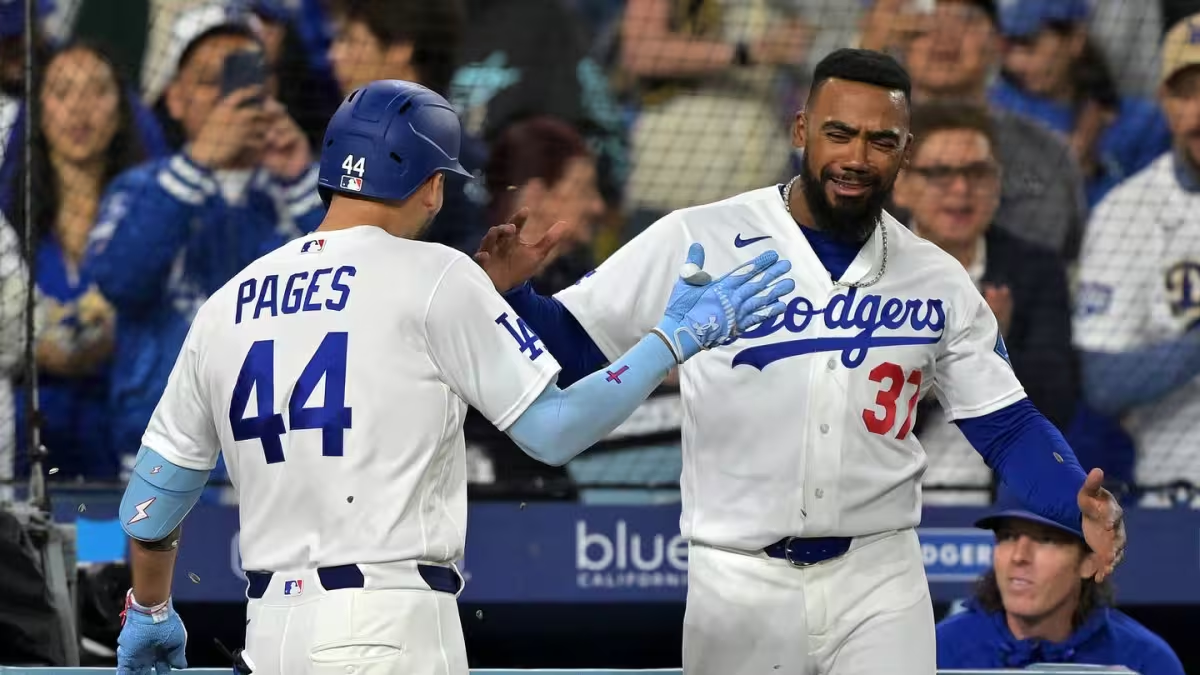
The roster picture makes the decision more consequential. Andy Pages has emerged and now owns center field, Teoscar Hernandez is signed through 2027 and feels fairly locked into left field, and Shohei Ohtani significantly reduces the playing time available at designated hitter. As one Dodgers insider put it bluntly: "you can’t play them all."
Put plainly, the Dodgers cannot plan on Tucker opting out. That forces two practical outcomes: payroll planning must account for a high AAV commitment over multiple seasons, and the club must reconcile that commitment with a crowded outfield and limited DH at-bats. Putting Tucker’s salary on the books as a steady element changes trade appetite, the urgency of adding outfield depth, and how the team allocates at-bats among established starters and emerging players.
The tension here is straightforward and real. Tucker’s pedigree is that of an elite bat — his career 138 wRC+ is evidence — but his 110 wRC+ this season is closer to ordinary than exceptional. That decline is the reason the Dodgers are treating the contract as a standing roster factor: current production does not justify the kind of market leverage that would make opting out a rational path for him.
Operationally, the Dodgers face a handful of awkward fits. Pages in center and Hernandez in left reduce the number of starts available in the outfield, and Ohtani’s presence at DH makes rotation plans tighter. That leaves fewer platoon possibilities and fewer natural openings for a full‑time role for every bat on hand. The club will have to balance playing time, matchups and long‑term payroll commitments while keeping development pathways open for younger players.
The single unresolved question that now matters is whether Tucker can re-create enough of his prior production to change the calculus. If his numbers climb back toward his career standard, an opt-out becomes plausible, and the Dodgers would face a different — and urgent — decision. If they do not, the sensible assumption for roster construction, payroll forecasting and trade strategy is that Tucker remains under contract through those player‑option years and the team must build around him rather than counting on his exit.
For the Dodgers, the safe play is to prepare for the scenario that removes uncertainty: treat Tucker as a long‑term roster and payroll commitment until he earns a reason not to be. The rest hinges on performance; his recovery or continued slump is the variable that will flip this from an accounting problem into a true roster decision.



