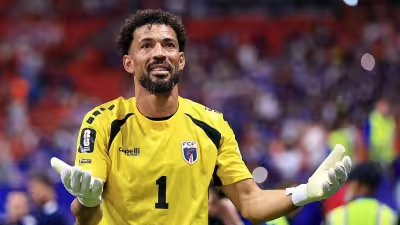
Nathan Ngoy appears in the global roll call. included him in its player-by-player presentations for the 2026 World Cup, placing him among three LOSC players as Belgium prepared to kick off against Egypt on Monday 15 June 2026 at 21:00.
The detail is simple but telling: produced profiles for every one of the 1,248 players at the tournament on the North American continent, and Ngoy turns up there before two of his LOSC teammates, Matias Fernandez-Pardo and Thomas Meunier. In the short space allotted to Fernandez-Pardo — the piece calls him an attacker "fast as lightning" and notes he is 21 years old — the tone is forward-looking and specific; Ngoy’s appearance sits in that same international frame without the same granular claim of role or status.

A local outlet that followed the trio highlighted how each was being presented abroad. Le Petit Lillois ran the three together, and an unnamed former coach quoted in the coverage offered one sharp line: "Il jouait comme Eden Hazard, mais sans le résultat final." It is the sort of image that travels — a comparison to a household name — but it does not resolve who on the pitch is expected to carry what responsibility for Belgium on Monday night.

That absence is the weight of the piece. Being included in a 1,248-player series gives Ngoy an international footprint; being one of three LOSC representatives gives him a local storyline amplified overseas. But the presentation does not say whether Ngoy is being positioned as a starter, a rotational option, or a squad presence for the opener against Egypt at 21:00. ’s profile frames perception; it does not set a lineup.
Context matters here because perception ahead of a major tournament can alter narratives at home and abroad. ’s project is part of a broader look at how LOSC’s Belgian internationals are seen on the world stage for this 2026 World Cup. For clubs and players alike, that framing feeds transfer talk, fan expectation and coaching decisions — even when the piece itself stays impressionistic rather than tactical.
The friction, plainly, is the gap between narrative and immediate consequence. Ngoy’s placement before Fernandez-Pardo and Meunier in the presentation generates attention; it does not answer whether Belgium’s manager will entrust him with minutes against Egypt. The profile invites questions about role and readiness without supplying the match-day signals managers ordinarily provide.
The next public moment is clear: Belgium faces Egypt on Monday 15 June 2026 at 21:00. For Nathan Ngoy, the match — not the profile — will determine how the international perception aired holds up under the glare of a World Cup opener. Whether he plays, and how much, will be the detail that turns a global mention into a tangible turn in his international standing.