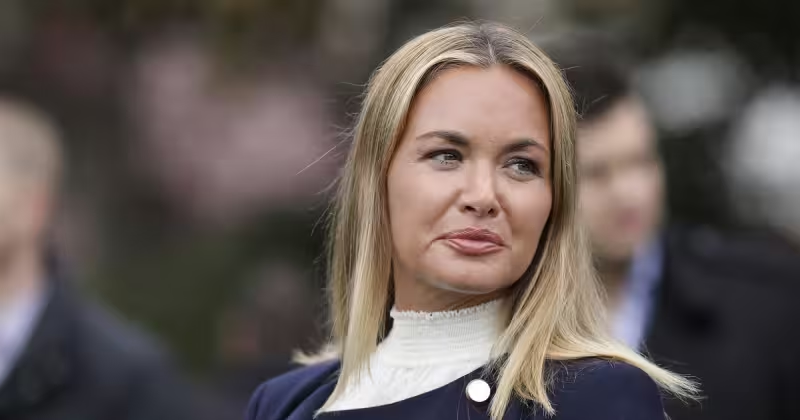
Vanessa Trump said Saturday she is beginning the second stage of breast cancer treatment after spending the past four weeks recovering from surgery, writing that she was "grateful to be healing and moving forward."
Trump, 48, who first announced her diagnosis in May, posted the update on Instagram and added, "Sending love, strength, and hope to everyone fighting this battle," a brief message that framed the move as personal and forward-looking.

The concrete timeline is the immediate news: surgery followed by roughly four weeks of recovery, and now an announced transition into the next phase of care. That sequence — surgery, pause, then follow-up treatment — is the clearest new detail she gave on Saturday.
Those facts matter because Trump is a public figure and a mother of five; her health updates draw attention on social platforms and among people watching how public figures manage serious illness. She told followers in May she was "working closely with her medical team on a treatment plan," and Saturday’s message is the first public confirmation that the plan has moved into its second stage.
Context: Trump is the ex-wife of Donald Trump Jr., and she shared both the May diagnosis and Saturday’s update on Instagram. She did not answer follow-up questions in the post, and she did not specify what type of breast cancer she has or what the next treatment will be.
That omission is the central friction in the update. Trump announced the move to a new treatment phase but left out two key clinical details that would change how the public — and medical observers — understand her prognosis: the cancer subtype and the nature of the upcoming therapy.
Subtype matters because breast cancer treatment paths diverge sharply depending on receptor status, stage and other diagnostic markers. Without that information, readers cannot infer whether the second stage will be chemotherapy, targeted therapy, radiation, hormone therapy or another modality; Trump’s post did not narrow those possibilities.
The shortness of Saturday’s message also constrained what reporters and readers could confirm. Her Instagram caption offered gratitude and encouragement but no medical specifics beyond the elapsed recovery time. The post did not identify the surgical procedure she underwent, nor did it name any planned adjuvant treatments.
Trump’s choice to keep details private is not unusual; many patients and public figures limit medical disclosure. Still, for a public update the absence of even a broad category of next steps — for example, "beginning radiation" or "starting chemotherapy" — creates a clear gap between the announced progression and what the public can verify.
For now the simplest facts stand: she is 48, a mother of five, announced her breast cancer diagnosis in May and said on Saturday she is entering a second stage of treatment after four weeks of surgical recovery. She expressed gratitude for healing and extended support to others facing breast cancer, but she did not specify tumor type or the next treatment phase.
The most consequential unanswered question is straightforward and narrow: what specific therapy will Vanessa Trump undergo next? That question determines both the likely side effects she will face and the timeline for further public updates.
Her next public communication — whether another Instagram post, a statement through representatives, or an interview — is the remaining route to answer it. Until she or her medical team supply those clinical details, the update will register as a personal milestone without the clinical clarity many readers seek.