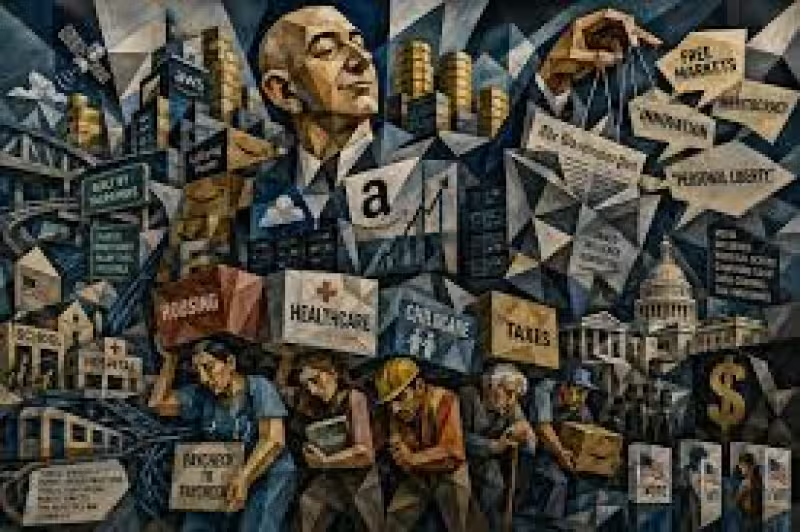
“I think what’s going on is that it’s kind of a tale of two economies,” Jeff Bezos said in May at Blue Origin’s Florida facility, opening a CNBC interview with a blunt picture of American life where some are prospering and others are struggling to pay rent and groceries.
Bezos said the public debate, too often, settles into finger-pointing. “They’re using this age-old technique of picking a villain and pointing fingers,” he told the interviewer, and then laid out his preferred alternative: find the real root causes and solve them.

That preference is not abstract for Bezos. He said Amazon approaches problems by digging until it reaches the underlying cause. “If we have a problem at Amazon, the way we would fix it is we’d go in and we’d do the five whys and we’d try to get to a root cause,” he said. “We try to find a root fix, and then we fix it at the root. You’re fixing it forever. It’s a real solution.”
The remarks land in the middle of a larger, loudly argued policy moment about wealth inequality and taxes. Bezos’s framing injects a familiar business discipline into that conversation: treat distributional shortfalls as system failures to be diagnosed, not moral dramas to be staged. That approach helps explain why a senior executive whose company has faced criticism on labor and compensation insists the remedy begins with analysis, not accusation.
Bezos tied the diagnosis back to people. “You have a bunch of people in this country who are doing really well, but you also have a bunch of people in this country who are struggling, struggling to pay rent, groceries,” he said, using the human scale of the problem as the justification for structural fixes rather than symbolic targets.



Some headlines ran with a shorthand that put the businessman and the tax debate together — the phrase Jeff Bezos Income Tax Proposal appeared as a framing device in coverage of the interview — but in the exchange Bezos did not sketch a concrete tax plan. He returned repeatedly to method over policy: stop assigning villains, use disciplined inquiry to find root causes, then fix them at the source. The interview confirmed his view; it did not commit him to a legislative blueprint.
The gap between headline and interview exposes the tension at the center of public debate: high-profile executives can shift the frame of the conversation without offering policy specifics, and those shifts shape what the public expects from lawmakers. For advocates and critics alike, the question becomes whether diagnostics that sound like managerial tools can be translated into redistributive policy that helps the people Bezos described.
That translation has proved contentious in recent years. Labor fights at Amazon — including a 2022 vote at a Staten Island fulfillment center and the firing that year of Chris Smalls, who later became a celebrity within the labor movement — helped push questions about pay and workplace power into the mainstream. Smalls’s profile and the union vote are part of the context Bezos’s remarks enter: they are practical reminders that debates over inequality are already being fought on the ground.
Bezos’s invocation of the five whys also matters because it ties a corporate problem-solving ritual to civic problems that respond differently to diagnosis. A logistics bottleneck at a fulfillment center can often be altered by management decisions; a family’s inability to afford housing intersects with housing markets, zoning, wages, and public benefits in ways that a single root-cause fix may not resolve.
That is the friction the interview leaves exposed. Bezos offered a mode of attack; he did not identify the specific policy levers that would make his approach materially different from the status quo. What remains unresolved is the essential practical step: which laws or spending decisions, if any, does he believe should follow from that diagnosis?
The most consequential unanswered question from the interview is not whether America has two economies — Bezos said it plainly — but which structural remedies he would back to help the people he described. He gave a prescription for how to think about problems; he did not, in this conversation, provide the prescription for what to do next.