



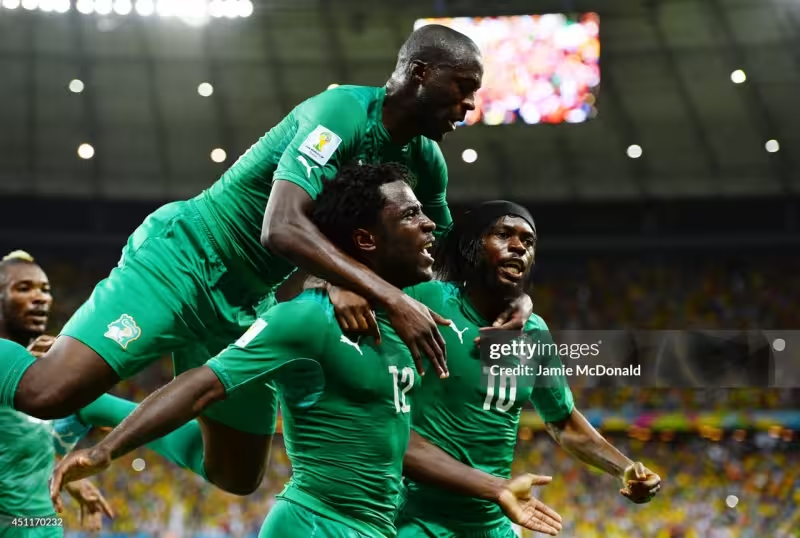
Bamba, who appeared in all three of Ivory Coast’s games at the 2014 FIFA World Cup in Brazil, died in August 2024 at the age of 39 after a long battle with cancer, and his passing has reopened questions about a squad remembered more for names than results.
He was there for the curtain-raiser — the 2-1 win over Japan — and for the narrow losses that followed. A defeat to Colombia and a last-gasp 2-1 loss to Greece, sealed when Georgios Samaras converted a late penalty, ended Ivory Coast’s tournament; a draw against Greece would have been enough for Côte d’Ivoire to progress.

The Samaras spot-kick is the decisive moment that still defines that group. It turned a team with world-class players into a headline about failure: Ivory Coast were knocked out at the first hurdle for the third successive World Cup, and the result removed any remaining cover from the label the squad carried — a so-called golden generation that included Didier Drogba and Yaya Toure.
Sabri Lamouchi was the manager in Brazil, responsible for stitching together a side that could name two of Africa’s biggest stars. But talent on paper did not translate to the knockout stage. The 2-1 win over Japan, a loss to Colombia and the late reversal against Greece left the group with a tidy numerical outline and a blunt outcome: high expectations, no knockout football.

That mismatch between reputation and result is the tension that follows many of the names from 2014. Some players drifted quietly from the international scene. Others stayed involved in the game in different roles. Boka, for example, finished his international career with 82 caps and was the starting left-back in Brazil after appearing in the two previous World Cups. His club career moved him from Beveren to Strasbourg in 2004 and later to VfB Stuttgart, Málaga and Sion.
Another member of that cohort, Barry, spent roughly 15 years in the Ivorian international set-up, made just under 250 appearances for Lokeren and retired from playing in 2019. He then moved into coaching, working as a goalkeeper coach at OH Leuven, Gent U21 and Lokeren-Temse — a path that probes the question many former players face: how to turn personal experience into a next chapter that benefits domestic football.
Bamba’s death refocuses those questions. He is not the only player whose career arc offered a mix of promise and unfulfilled tournament ambition, but his participation in all three Brazil matches means his passing is also a closing of a physical link to the team that could not clear a modest group-stage bar. The loss is personal and symbolic: the last of several reminders that having big names is not the same as building a system that wins at major tournaments.
What became of the rest of that 2014 group is uneven. Some carved out steady club careers, some moved into coaching, and others vanished from the international conversation. The record is plain: by the end of Brazil 2014, Ivory Coast had failed to progress from the World Cup group stage for the third straight tournament, and the careers that followed did little to alter that statistical footnote.
The most consequential question now is not only who from that team stayed in the game, but whether the Ivorian federation can translate those individual legacies into collective progress. Bamba’s death is a moment to catalogue where the names went — Boka’s 82 caps, Barry’s coaching shift — and to reckon with why a roster stocked with talent still could not move past the group stage. That reckoning will determine whether the memory of Ivory Coast’s most celebrated players becomes a foundation for future campaigns or a repeated reminder of promise unfulfilled.



