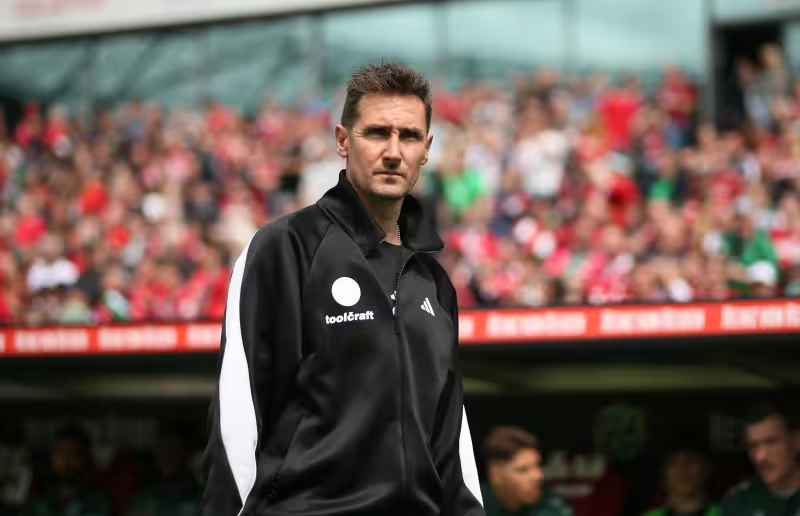
Miroslav Klose has made a choice: the soon-to-be 48-year-old who left the international stage as a World Cup winner in 2014 is now the head coach of FC Nürnberg on a deal that runs to 2028. It is the clearest signal yet that the man who finished his playing career in 2016 has settled into a long-term life in management.
The headline that follows him is unmistakable. Klose finished his World Cup career with 16 goals across four tournaments — 2002, 2006, 2010 and 2014 — overtaking Ronaldo Nazario’s mark to become the competition’s all-time top scorer. In Brazil in 2014 he made two substitute appearances in the group stage, scored against Ghana, sat out the Round of 16 tie with Algeria, then started against France in the quarterfinal, Brazil in the semifinal and Argentina in the final; his second‑half strike against Brazil remains one of the tournament’s defining moments.

That tournament and its image of Klose’s front flip celebration are part of a broader FilmoGaz series revisiting members of Germany’s 2014 World Cup-winning team. For Klose, the memory of the final is only one chapter: he retired from international football right after the 2014 World Cup and two years later ended his professional playing career.
Retirement did not mean stepping away. Klose moved into coaching almost immediately. After hanging up his boots he first worked as an assistant coach and then took charge of Germany’s U17s, a post he held until 2020. Those years were a basic apprenticeship — working with youngsters, learning the rhythms of training and match preparation, and converting instinctive striker habits into coaching language.

In 2020 Klose moved to Bayern Munich and spent one year as an assistant to Hansi Flick. That single season at Bayern placed him inside an elite coaching environment and linked his name to one of Europe’s top staffs. After Bayern he took a club appointment with Rheindorf Altach, and from there his path led to FC Nürnberg, where his current appointment runs to 2028.
The friction in Klose’s story is obvious: he retired from international football immediately after the 2014 World Cup but never left the game. Instead of fading into punditry or private life, he followed a steady, incremental route into management — assistant work, youth coaching, a top‑level apprenticeship at Bayern, then head-coach posts. The transition from world-class striker to long-term coach is not automatic; each stop along the way has been a test of whether his on-field instincts translate to organizing teams and developing players.
That test is precisely where the open question sits. His four-year contract at FC Nürnberg gives him time — and it publicly commits the club to a multi-season program under his leadership — but it also raises the benchmark. Nürnberg have bound Klose to a period in which measurable progress, squad building and results will define his record more than his World Cup résumé.
For fans who remember the 2014 World Cup and Klose’s goals for Germany, the appointment reads like a career arc completed: record-holder turned committed coach. For Klose himself, the move to Nürnberg is less an epilogue than a working chapter — a chance to prove that an elite striker can do the less glamorous, slower work of management over multiple seasons. The contract to 2028 makes his intentions plain; the coming matches and league tables will show whether the player who beat Ronaldo Nazario’s World Cup mark can do the same at the other end of the touchline.