



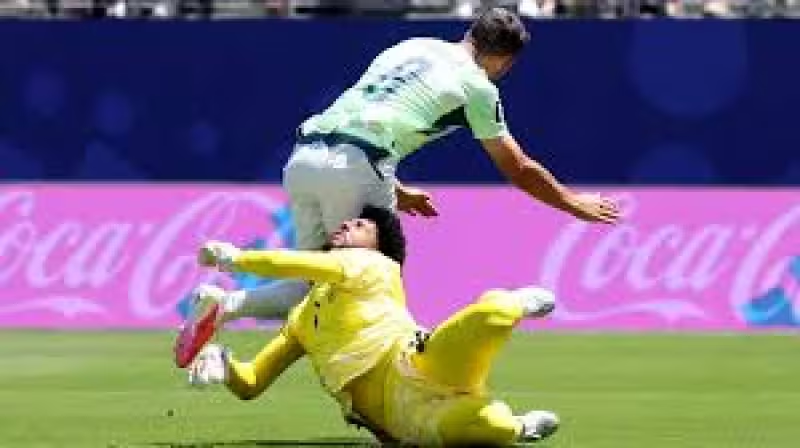
FIFA said a brief technical outage prevented its onside animation graphic from being generated after Switzerland were awarded a penalty in a 1-1 World Cup Group B draw with Qatar in Santa Clara on Saturday, a failure that left the decisive visual missing at the moment the goal was given and forced a late release of images.
Breel Embolo converted the spot-kick that made the score 1-1. FIFA released images four and a half hours after the incident showing the build-up and the positions of the players; the federation said the outage was short and that the VAR workflow itself "was not affected by this issue and followed the normal procedure in checking the on-field decision." FIFA also said the drawn VAR lines used in the checks did not show the attacking player to be in an offside position.

The sequence involved two Switzerland players who could potentially have been offside immediately before the penalty. FIFA provided an image of Embolo in the build-up and a separate image for Remo Freuler prior to the foul by Qatar goalkeeper Mahmoud Abunada. Because the semi-automated offside animation — the advanced graphic FIFA has promoted for this tournament — did not generate, match officials reverted to drawn lines on the pitch for the checks.



That reversion is a familiar fallback: FIFA promoted the enhanced semi-automated offside system before the tournament and scanned every player to create lifelike avatars for the animation. When the automated graphic is unavailable, officials use the manually drawn VAR lines to make the offside assessment, the same basic principle used in leagues where technology has occasionally failed.
The immediate fallout was partly technical and partly public. Commentators and viewers noticed the absence of the onside animation at the time of the decision; on ITV, Gary Neville said, "We all think [it was offside]" before FIFA issued its explanation. That timing — a high-profile pundit declaring certainty before the governing body released its images and reasoning — amplified doubts even as FIFA said the VAR checks found no offside in either of the two situations immediately before the penalty.
The central unresolved fact is simple and consequential: FIFA has not explained why the animation failed to generate or why the images were only published four and a half hours later. The federation's statement says the lines used by the VAR did not show an offside and that the VAR workflow followed normal procedure, but it stops short of a technical post-mortem that would say what failed and why the automated graphic could not be produced in real time.
FIFA's word that the VAR workflow was unchanged and that the drawn lines cleared the attackers stands as the official record of the decision. But the late release of the visuals and the immediate, public assertion by pundits that the move looked offside leave the outcome publicly contested. The single most consequential unanswered question now is the cause of the system failure and whether FIFA will provide a detailed technical explanation to restore confidence in the semi-automated tool used in live decisions.



