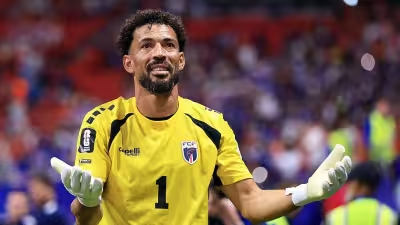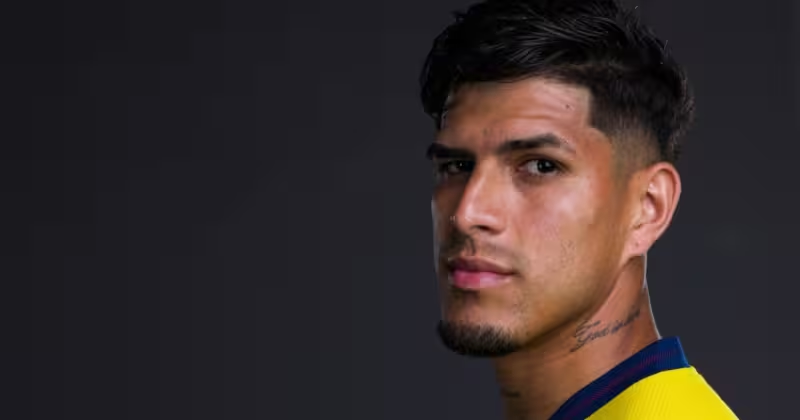
"Esta selección juega con el corazón," Piero Hincapié declared in a Telemundo feature published June 14, 2026, a short, blunt line that the Ecuadorian defender used to sum up how his team carries itself at the Copa Mundial.
Hincapié did not stop at that sentence. In the piece he framed La Tri around three qualities: unity, the grit that has come to define this group, and a stated commitment to represent millones de ecuatorianos both inside and outside the country. The defender's words were offered as an identity statement — less a tactical readout than an appeal to conscience and pride.

The detail that gives the quote weight is simple: it came from a central figure in Ecuador's back line during football's biggest stage. Hincapié's position and visibility mean his description is not private sentiment; it is how a team leader chose to present the squad to a global audience at a moment when national narratives matter as much as formations.
Context matters and, in the feature, the context is the Copa Mundial. Telemundo set Hincapié's remarks against that tournament backdrop, using his voice to stitch together a portrait of La Tri as a collective that plays hard and stands for something beyond results. That framing — heart, unity, representation — was the lens the feature used rather than match reports or scorelines.
That framing is also the story's central friction. The piece emphasizes emotion and identity without anchoring those claims to any competitive outcome. Hincapié's words were persuasive rhetoric: they describe a desirable character but do not show it in a result, a turning point, or a specific fixture. The feature presents how the team wants to be seen; it does not demonstrate whether that self-image has translated into match-winning play at this Copa Mundial.
Read this way, Hincapié's quote functions as a rallying cry. It invites Ecuadorians to view La Tri as a symbol of national cohesion. It also invites a question the feature leaves open: was this line aimed at shoring up belief before a particular game, or is it a general manifesto for the tournament? The feature did not link the comment to a named opponent or a specific match plan, a gap that matters to fans trying to connect rhetoric with results.
The omission is consequential because claims of unity and grit carry different weight when attached to a comeback, a defensive shutout, or a knockout upset. Without a result attached, Hincapié's portrait remains persuasive but untested in the narrative the feature chose to tell. For supporters inside and outside Ecuador, the promise to represent millones de ecuatorianos is meaningful; whether that promise will be proven on the pitch is a separate question the feature did not answer.
What comes next is plain and unresolved: Hincapié's words will be measured against whatever La Tri produces next in the Copa Mundial. The Telemundo piece delivered an image of identity and intent on June 14, 2026; it did not schedule a moment for validation. That absence leaves the single, most consequential question open — which fixture will transform Hincapié's claim into evidence — and it puts the onus back on the team to make the pride he described translate into a result fans can point to.