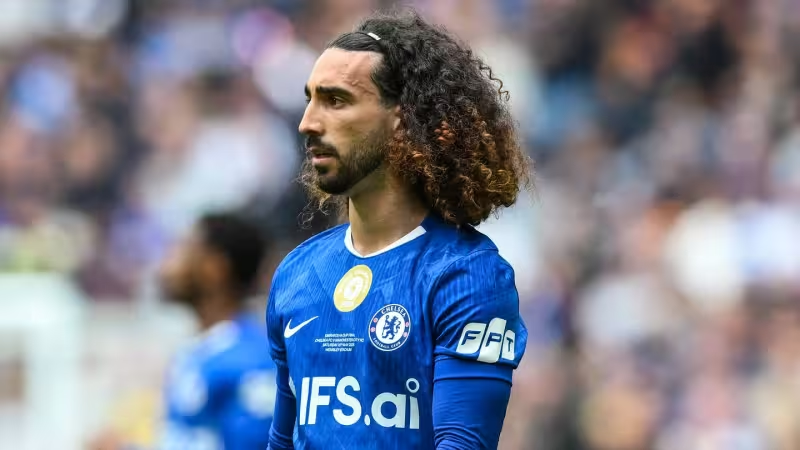
"I’ve spoken with him and he inspired a lot of confidence in me," Marc Cucurella said this week, adding that he had also checked in with Alejandro Grimaldo and Borja Iglesias about Xabi Alonso’s project. The Chelsea left-back’s endorsement of the incoming manager is the clearest public sign yet that Alonso has already begun to influence one unsettled first-team player.
Cucurella’s comment carries weight because it arrives while multiple clubs in Spain — notably Barcelona and Atlético Madrid — are reported to be keen on signing him this summer, and because he has openly admitted an interest in returning to Spain. Grimaldo’s recent season under Alonso at Bayer Leverkusen is a concrete part of the pitch: in Leverkusen’s title-winning 2023-24 campaign, Grimaldo produced 12 goals and 20 assists working in Alonso’s 3-4-3 system, a performance Cucurella has clearly used as a reference point.

The timing matters. Cucurella made the remarks after a period in which he publicly criticized Chelsea’s regime following the departure of former manager Enzo Maresca. He has been increasingly linked with a summer exit, and there are reports that Maresca would like to reunite with him at Manchester City. Those threads—public complaint, transfer speculation, a manager who appears to have Grimaldo-level credibility—converge on the question of whether Chelsea can keep an unsettled first-team player as the window opens.



Alonso’s tactical footprint is central to why Cucurella’s words will be parsed. At Leverkusen Alonso deployed a 3-4-3 that turned a wing-back into one of Europe’s most dangerous wide players; at Real Madrid his teams tended toward 4-3-3 or 4-2-3-1, systems that place different physical and positional demands on a left back. Cucurella did not outline what Alonso told him or promise to adapt to any single formation, but invoking Grimaldo and Iglesias—players who worked with Alonso—amounts to a tacit assessment that the coach’s methods and reputation matter to his decision.
The friction in Cucurella’s position is plain. He has publicly criticized the club’s recent direction, and speculation about a summer move is real. Yet he has now praised the man taking charge and sought reassurance from players who thrived under him. That pulls against the narrative of an inevitable departure: a player who has his doubts about his club might still be persuaded to stay by a manager he trusts. It also complicates the bargaining picture for potential suitors in Spain; Barcelona and Atlético face a player who has signaled both homesickness and a professional appetite to work under Alonso.
Cucurella’s statements stop short of committing his future. He has said he has spoken with Alonso and that the conversation inspired confidence; he has not said he will remain at Chelsea or that he will push for a transfer. For Chelsea, the message is double-edged: the incoming manager’s credibility may strengthen the club’s hand in retention, but Cucurella’s earlier public criticism and admitted desire to return to Spain give buyers reason to believe a deal can be struck.
The unresolved question is simple and stark: will Cucurella convert verbal confidence in Alonso into a renewed contract or a renewed case for staying, or will the summer transfer market and interest from Barcelona, Atlético and others deliver him back to Spain? With Alonso’s arrival imminent and the transfer window approaching, the next public movement—contract talks, a clear declaration of intent from the player, or a firm bid from an interested club—will determine whether Cucurella’s praise translates into a new chapter at Chelsea or the start of his exit.