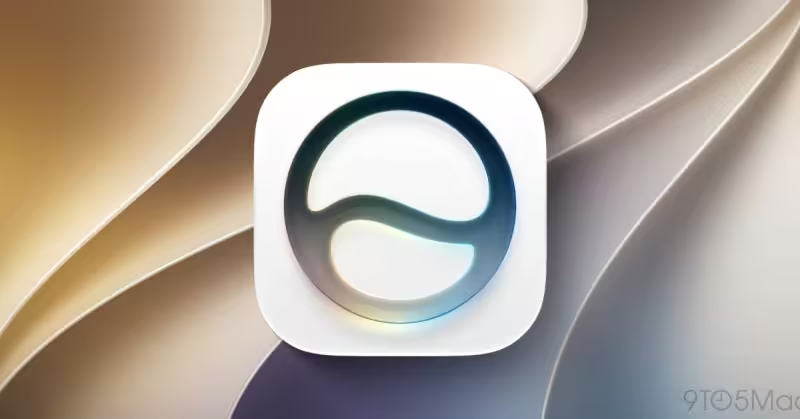
Apple announced iOS 27 at WWDC this week and for the first time will ship Siri as a pre-installed, standalone app on the iPhone Home Screen when the update rolls out later this year.
The new app is a notable product change: Apple says the Siri app lets users revisit past conversations and start new ones in a chat-style interface that syncs across devices via iCloud. It will appear on iPhone after users install iOS 27 and will also arrive on Mac with macOS 27, Vision Pro with visionOS 27, iPad with iPadOS 27 and Apple Watch with watchOS 27.

Under the hood, iOS 27 Siri app features center on continuity and context. Conversations are presented as a stream so you can scroll back through exchanges; you can upload photos and files for Siri to analyze; and Siri can reference messages, emails, photos and other personal context when answering specific questions. The assistant can also recognize what’s on a user’s screen and respond to queries about it, and those interactions are intended to follow you from device to device thanks to iCloud syncing.
Apple framed the release as part of a broader push around Siri and Apple Intelligence. The company has been expanding the slate of pre-installed apps on iPhone in recent years: iOS 26 added Preview and Games, and Apple introduced Image Playground in iOS 18.2 in December 2024. The Siri app sits alongside those additions as the first time Siri arrives as its own Home Screen icon on iPhone.


The practical limit on that rollout is the friction developers and users will notice immediately: Apple says the Siri app will be available only on devices that support Apple Intelligence. The company’s messaging indicates Apple Intelligence support covers the iPhone 15 Pro and newer, which means owners of older iPhones will not see the new app after the iOS 27 update. Apple has not published a feature-by-feature map showing which Siri functions require Apple Intelligence and which will run on less capable hardware.
That omission matters because the Siri app is a bundle of capabilities, not a single switch. Some parts—like the chat-style archive and iCloud syncing—are straightforward infrastructure changes. Others—on-device analysis of images and screen content, or responses that pull on broad personal context—may depend on Apple Intelligence to run smoothly or privately. Without a clear breakdown, users and IT managers will have to wait for release notes or testing to know whether a given interaction will be available on their phone.
The update schedule is simple: iOS 27 and the new Siri app are set to arrive later this year. When the software ships, users with supported hardware will find a Siri icon on their Home Screen and can begin using the conversation history, file uploads and cross-device continuity immediately; Mac, iPad, Vision Pro and Apple Watch users will see corresponding apps once their platforms update. Tech writer Chance Miller asked readers what they thought of the change, signaling early interest in how the app will alter everyday use of Siri.
The single unresolved question left by Apple’s announcement is also the most consequential: which specific Siri app features will be gated by Apple Intelligence and which will function on older devices? Apple will need to clarify that before the rollout if users are to understand whether iOS 27 will change Siri for everyone or only for those on newer iPhone models.