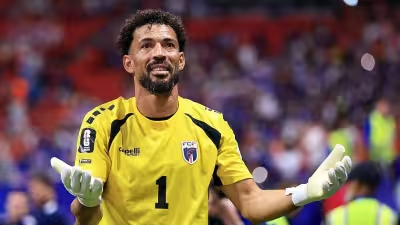
"We want to support both kids and both countries," Jack Souttar says, and then he laughs at the logistics: two first‑round World Cup games separated by roughly 3,000 miles and six days. From their home in Luthermuir, Aberdeenshire, Jack and Heather Souttar are suddenly caught between gold and blue as their younger son, Harry Souttar, lines up for Australia while their elder son, John, makes his World Cup debut for Scotland.
That split is more than symbolic. John, who first played for Scotland in 2018, is a defender with Rangers after earlier spells at Dundee United and Hearts. Harry, also a defender, has been a regular in the Australian squad since 2019 and moved from Stoke to Leicester City in his club career. Heather was born in Australia; Jack once turned out for Brechin in his youth. Between them the couple have three sons and two daughters.

Jack frames the situation simply: the family will back both boys and then let the rest happen on the pitch. He says the brothers are close — there was scuffling when they were younger, he adds — and that they habitually talk to each other about their matches and look out for each other. Those private routines matter now because supporting two nations at the same World Cup is rare and, for the Souttars, immediate and physical.
The arithmetic of that rarity is sharp. The first‑round matches the Souttars plan to follow are separated by roughly 3,000 miles and a six‑day gap, meaning travel, time zones and schedules beyond a typical fan's weekend trip. For a family used to local ties and club loyalties, the logistics are an intrusion: flights, hotels and the quick turnarounds that come with elite international tournaments.

The brothers’ backgrounds make the split understandable. Harry’s tie to Australia is through his mother and his international career has been established since 2019. John’s path to Scotland’s national team stretches back to his first cap in 2018. Both men have built professional résumés in the British game — Harry at Stoke and then Leicester City, John at Rangers following spells at Dundee United and Hearts — but their national allegiances pull their parents in opposite hemispheres this month.
That pull is the story’s tension: pride and practicalities. Jack says it "was never a task for us" to support their sons; the family simply accepts both as their own. Still, a single family cannot be in two places at once. If both teams advance, choices will be forced; if one side is eliminated, the decision becomes trivial. Either way, the first‑round schedule makes those outcomes immediate concerns for Jack and Heather.
The Souttars have long been around football. Jack’s own youth appearances for Brechin and the boys’ club careers mean matchday routines are familiar, but nothing in their experience quite matches following two siblings in opposing national colours at a single World Cup. The brothers' close relationship — roughhousing as kids, now steadying each other with match talk — underlines why Jack and Heather want to be at both games, even if getting there will be an exercise in compromise.
What happens next is the unresolved part of the family plan. The World Cup is underway and both sons are playing. Jack and Heather must still decide which first‑round matches to attend in person and how to move between venues if both prove urgent. For now the decision is less about choosing a winner than about arranging seats on a very long trip and keeping two sons, in two shirts, feeling like both are at home.