



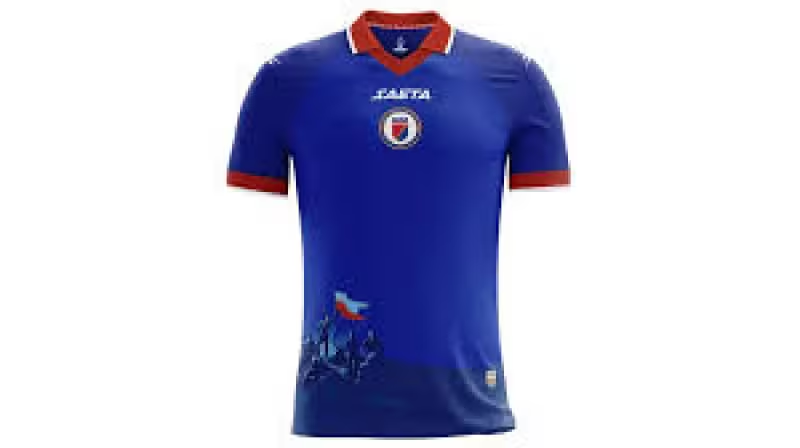
FIFA ordered Haiti to remove imagery tied to the Haitian Revolution from its 2026 World Cup shirts, and the team appeared in revised jerseys at official tournament portraits on Tuesday, days before Haiti opens its group against Scotland on Saturday.
The contested iconography — a small silhouette motif placed on the right hip and inspired by the Battle of Vertières and the Revolution that led to Haiti’s independence in 1803 — had been printed on all three Saeta designs: the blue home shirt, the white away shirt and a red third kit. All three versions sold out on Saeta’s website after their unveiling, but FIFA concluded the elements were political in nature under its equipment regulations and requested changes during the mandatory review.

Saeta said it worked with the Haitian Football Federation to implement FIFA’s requests. "Working in close collaboration with the Haitian Football Federation, our objective throughout the process was to create a jersey that celebrated the pride, resilience and spirit of the Haitian people," the manufacturer said. "The final design presented by Saeta was intended as a tribute to the men and women who contribute every day to Haiti’s future and was not intended as a political statement." It added: "During the review process, FIFA determined that certain visual elements could be interpreted differently under its equipment regulations and ultimately requested modifications to the design."
The practical consequence is immediate: the shirts that supporters bought — and that the national team wore in friendlies last week against New Zealand and Peru — will not be the shirts the players wear in official World Cup fixtures. In photos taken at FIFA’s session on Tuesday, the Haiti squad posed in plain shirts without the right-hip iconography.
That change arrived on the eve of the tournament and matters because Haiti is making its first World Cup appearance since 1974, having advanced from CONCACAF qualifying for the first time in more than four decades. The altered kit will now be part of the team’s first global impression in matches and media widely seen around the world, and supporters who bought the original Saeta shirts will not see that exact design on the field.
The decision also adds to a pattern this year: this is the second time Haitian team apparel has been redesigned before an international tournament. The imagery at issue was explicitly tied to national history — the silhouettes referenced the November 18, 1803 Battle of Vertières and the actions around Jean-Jacques Dessalines that preceded the declaration of independence on January 1, 1804 — which appears to be why FIFA treated the elements under its political-content rules.
There is friction at the center of the change. Saeta and the Haitian Football Federation say the motif was a cultural tribute, not a political message; FIFA judged the same visuals could be viewed differently within its equipment regulations and therefore required modification. Saeta says it "successfully implemented the requested modifications during the mandatory review process," but provided no full public image of the final approved design.
The main unanswered question now is straightforward and consequential: what exactly will Haiti wear when it plays Scotland on Saturday? Sources show only that the team has removed the contested iconography from the shirts used in official portraits; the exact appearance of the match kit the side will use — beyond the plain versions photographed on Tuesday — has not been detailed in the materials released so far.
Haiti’s immediate course is fixed: the squad will travel into the World Cup having replaced the now-banned elements and will wear the modified kits in tournament play. The single detail to watch next is the official match-day photography and the teamsheet for Saturday’s opener — that will reveal whether the approved alternative is a simple clean version of the sold-out Saeta shirts or a visibly different design altogether.



