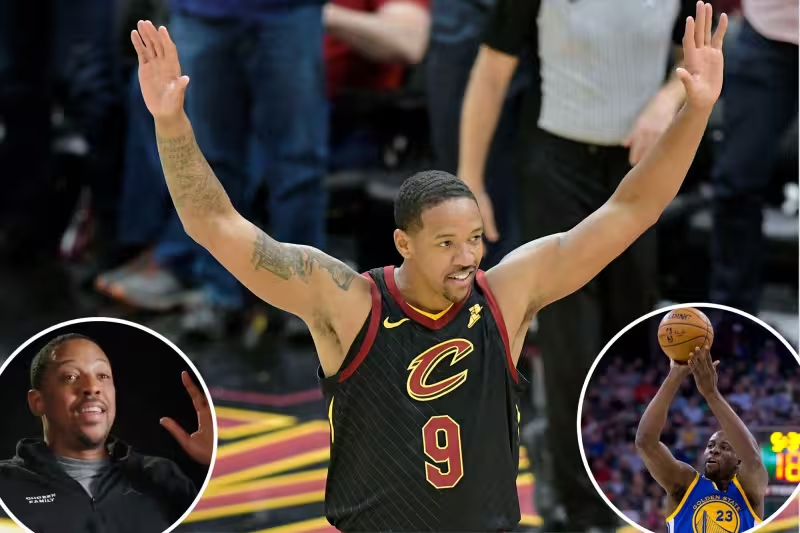
“I am a firm believer that even if Draymond [Green] was there, we would have still put that belt on ’em,” Channing Frye told a feature reflecting on the 2016 NBA Finals, adding with a grin, “Unless he would have grown two more arms, and 6 more inches, no.” The former Cavaliers big man made the comments in a Bleacher Report interview marking the 10-year anniversary of Cleveland’s 3–1 comeback.
Frye’s claim lands against a single-game ledger that has become part of Finals lore. Game 5 — the night Golden State’s Draymond Green was suspended after his fourth flagrant foul of the postseason and forced to watch the contest next door at the old Oracle Arena from the Oakland Coliseum — finished 112–97 in Cleveland’s favor. LeBron James and Kyrie Irving each scored 41 points that night, and the pair combined for nine 3-pointers; Frye insists those numbers were decisive regardless of who the Warriors could field.

In the interview Frye pushed back on the take that Green’s absence alone swung the series. He pointed to injuries and matchups: Andrew Bogut and Festus Ezeli were out by the end of the series, which, Frye said, “made it easier for Cleveland to attack the rim and play more physically.” He added that without Green on the court and “no big man on the court, James and Irving had a major advantage,” and offered a terse salute to his opponents — “Total respect to Golden State, but it was like two sword fighters.”
The sequence that followed Game 5 only deepened the Cavaliers’ claim. Cleveland closed out the Warriors with a 115–101 win in Game 6 and then a 93–89 victory in Game 7 to capture the franchise’s first NBA title. Frye’s remarks come as a decade’s distance from that run, when the Cavs overturned a 3–1 deficit and LeBron James claimed his first championship in Cleveland.
That is where the friction sits. For many, Green’s suspension is a turning point: the flagrant count that kept him out of Game 5 is widely cited as a moment the Warriors lost control. Frye rejects that framing. He described the Cavaliers’ play in those games with a mix of disbelief and admiration — “I don’t know what happened with those boys; they went to the moon,” he said — and recalled the quick, almost surreal way Cleveland’s offense took over: “You just hear the noise, and then they’re over there, and you’re like ‘Damn, when did that happen?’ ”
Frye’s version reframes the episode as one of agency rather than absence: the Cavs didn’t merely benefit from a vacant roster spot; they imposed their will through the two 41-point nights and follow-up wins that finished the series. It is a declarative view that collides with a simpler counterargument — that Green’s suspension removed a defensive and playmaking presence whose absence mattered — but Frye refuses to split credit that way.
There is no new event on the calendar tied to Frye’s comments. What his interview does, plainly, is sharpen an old debate: was Game 5 the result of what Golden State lost, or what Cleveland became? Frye settles the question for himself and hands the rest of basketball history a stubborn, evidence-backed claim — that the Cavaliers earned those final three wins on their own terms.