Zohran Mamdani stood before a row of hand-stitched shirts and framed the launch with a simple claim: "Jerseys represent more than just the team you support." He announced a limited run of 1,500 NYC-inspired World Cup jerseys the city will sell at cost, saying the pieces are meant to be "about pride in where you come from and who you are."
The practical details are spare and decisive. The drop — three colorways of 500 shirts each, in black-and-white, yellow-and-black, and blue-with-orange-red — will be available in person only at the NYC City Store’s One Centre Street location, starting at 9 a.m. on Friday, June 12. The shirts were priced "at cost" at roughly $50 and will be handed out on a first-come, first-served basis when sales open.

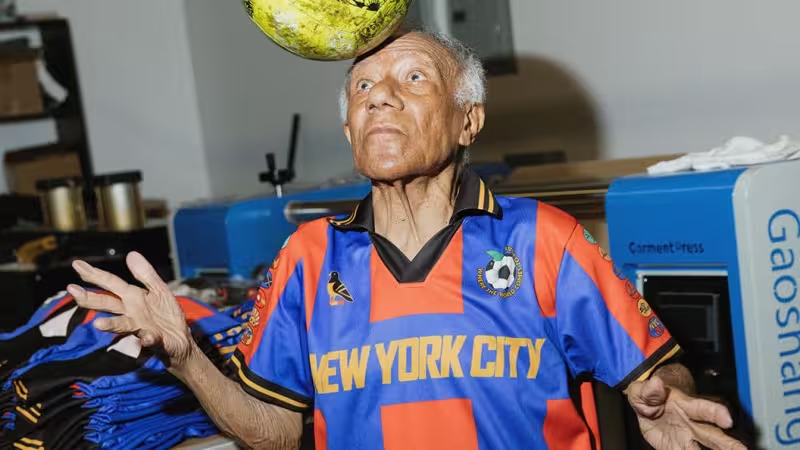
Those numbers are the story’s weight: 1,500 shirts, 500 of each color, $50 apiece. The jerseys were designed by Arsh Raziuddin and produced by Mazzi Sports, a family-owned apparel studio that stitched the shirts by hand at its Bedford-Stuyvesant factory. The design is literal about New York — a soccer-ball-ified Big Apple over the heart, a pigeon on the opposite side, NEW YORK CITY across the chest and the number 26 on the back.
Mamdani framed the release as a civic gesture. "With this limited run, we are offering New Yorkers an affordable jersey made for New Yorkers, by New Yorkers," he said, and thanked Mazzi: "I want to thank Mazzi for partnering with us to make sure that nobody is priced out of showing pride for our city." His office has also secured 1,000 $50 tickets to games at MetLife Stadium and organized free fan events and watch parties across the five boroughs as part of the World Cup effort.

Mazzi’s presence in the story is more than a supplier line. The company traces back to Alexander Campaz, who began making jerseys in Colombia in the 1970s and emigrated with his family to New York in 1983. Mazzi’s production facility moved through Jackson Heights, Midtown and East New York before settling in Bed-Stuy in 2020. At the height of the pandemic that year the factory pivoted to making medical gowns, producing about 20,000 a week and keeping over 100 people employed.
That pedigree — neighborhood factory, pandemic pivot, family founder — is what Mamdani leaned on in pitching the drop as local and democratic. Still, the campaign carries an embedded friction: selling at cost is uncommon for city-branded merchandise, but the choice to cap the run at 1,500 creates immediate scarcity. A shirt priced to be affordable can still vanish within minutes when there are only 500 of each color and sales are in-person only.
The question Mamdani’s office left open is how fast New Yorkers will translate goodwill into a line outside One Centre Street. The mayor predicted broad interest: "I just want to be everywhere," he said, adding that "There’s a magic that comes alive in the city, and it comes alive no matter where the World Cup is." If the shirts move as quickly as similar limited drops, the physical sale could end within hours or less.
Context sharpens the stakes. The release is tied to the 2026 FIFA World Cup — billed as the most expensive edition in history — and the mayor’s other moves around the tournament suggest a push to make events accessible: the $50 tickets at MetLife, the watch parties, the City Store drop. Observers who want to read more about how Mamdani’s office has been shaping civic events and controversies can see prior coverage at FilmoGaz, including the mayor’s handling of a Gracie Mansion reception and his wider political moves.
The immediate next moment is concrete and public: the in-person sale at the NYC City Store, One Centre Street, at 9 a.m. on Friday, June 12. Beyond that, the unresolved measure of success is not rhetoric but time — how long until the last of the 1,500 shirts is gone, and whether the limited run will feel like genuine affordability or an engineered scarcity that left many New Yorkers empty-handed.