



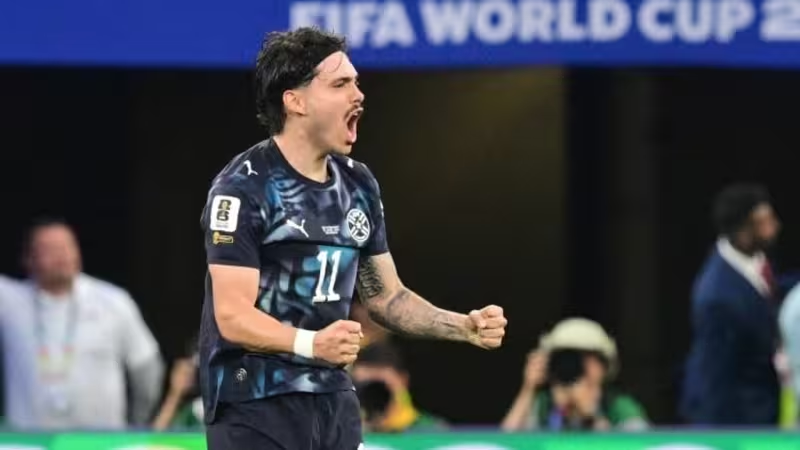
Maurício came off the bench at halftime and scored Paraguay’s only goal in a 4-1 defeat to the United States on Friday, delivering the first World Cup goal by a Palmeiras player since 2014.
The finish was blunt and immediate: with the U.S. leading 3-0, Maurício burst into the box and struck a first-time shot that found the net, a moment that ended a 12-year scoreless run for Palmeiras representatives at World Cups. Valdívia had been the last player from the São Paulo club to score on football’s biggest stage, in Chile’s 3-1 group win over Australia at the 2014 tournament.

The strike matters to club and player at once. Maurício, 24, is making his first World Cup appearance as a naturalized Paraguayan after a career that began in São Paulo: he came through Desportivo’s youth ranks in Porto Feliz, moved to Cruzeiro in 2019, played 32 matches and scored five goals for Cruzeiro in 2020, then transferred to Internacional where he totalled 25 goals in 176 appearances before joining Palmeiras in 2024. At Palmeiras he has 18 goals in 105 games.
How Maurício arrived on the pitch is part of the story. The main pre-match uncertainty for Paraguay was Julio Enciso’s fitness after a muscular injury. In training in Los Angeles, Maurício had been viewed as the leading candidate to replace Enciso if the forward could not recover; Enciso returned to full training on the eve of the game and was named among the starters. Ramón Sosa began on the bench because he had not been a regular in coach Gustavo Alfaro’s preferred pre-tournament starting formation.

That selection dynamic—the player most likely to start if Enciso failed to recover being left on the bench once Enciso proved fit—is the friction here. Maurício answered the coach’s choice with the clearest possible argument a substitute can make: an instantaneous, measurable contribution. The goal does not change the match result, but it changes the record book and the immediate evaluation of the three attacking options competing for minutes.
For Palmeiras supporters the statistic is tidy and sharp: the club had gone 12 years without one of its players scoring at a World Cup. For Paraguay’s staff the moment creates a practical selection question. Enciso’s recovery had been decisive before kickoff; now Maurício has provided direct evidence that he can alter a game when introduced. Ramón Sosa’s bench role reflected Alfaro’s base lineup, not a final verdict on his importance to the squad, but Sosa’s absence from the start and Maurício’s impact complicate any simple rotation plan.
The game gives Alfaro three clear pieces of evidence to weigh in future selections: Enciso’s fitness and form, Sosa’s place in the coach’s tactical baseline, and Maurício’s effectiveness as an in-game option. Maurício’s World Cup debut and his landmark goal make him more than a contingency name on a pre-tournament list; they force a choice between continuity and recent, demonstrable impact.
Because selection decisions hinge on fitness, tactics and the coach’s appetite for change, Maurício’s finish is unlikely on its own to displace Enciso immediately. It does, however, make him impossible to write off. The clearest near-term consequence is tactical: Maurício has shifted from favored emergency starter to a proven game-changer, and Alfaro now faces a genuine dilemma about whether to start the recovered Enciso, stick with the formation that omitted Sosa from the first XI, or reward the substitute who ended Palmeiras’ World Cup drought.
Readers tracking players named Mauricio across sports can find related coverage on FilmoGaz, from coaching decisions to roster moves, as background to how a single name appears in multiple contexts on and off the pitch.



