
FIFA is introducing new offside rules and a semi-automated offside system across the 104-game World Cup this year, and every match will be governed by the same timing and punishment mechanics that define offside in soccer.
At its simplest, a player is offside the moment a teammate touches or plays the ball and any part of the attacker’s head, body or feet is in front of the last defender. That measurement is literal: every inch counts. If the referee judges a player offside at the instant the ball is played, the result is an indirect free kick taken where the offence occurred — and any goal scored without the ball first being passed to another player after that call will be ruled out.

How do players avoid being flagged? The basic tactic is awareness: attackers check whether a defender is further up the field before committing to a run or touch. Teams train to stretch and time runs to stay level with or behind the last defender until the ball is played; when they fail, the rules hand possession back to the defending side via that indirect free kick.
The refereeing consequences fit a clear progression. A yellow card is a formal warning from the referee; a player can receive one for arguing with officials, deliberately running down the clock or other questionable conduct. A first yellow means the player remains in the match. A second yellow in the same fixture — or an accumulation that triggers suspension in a later match — results in immediate removal from the pitch and suspension for the next match.
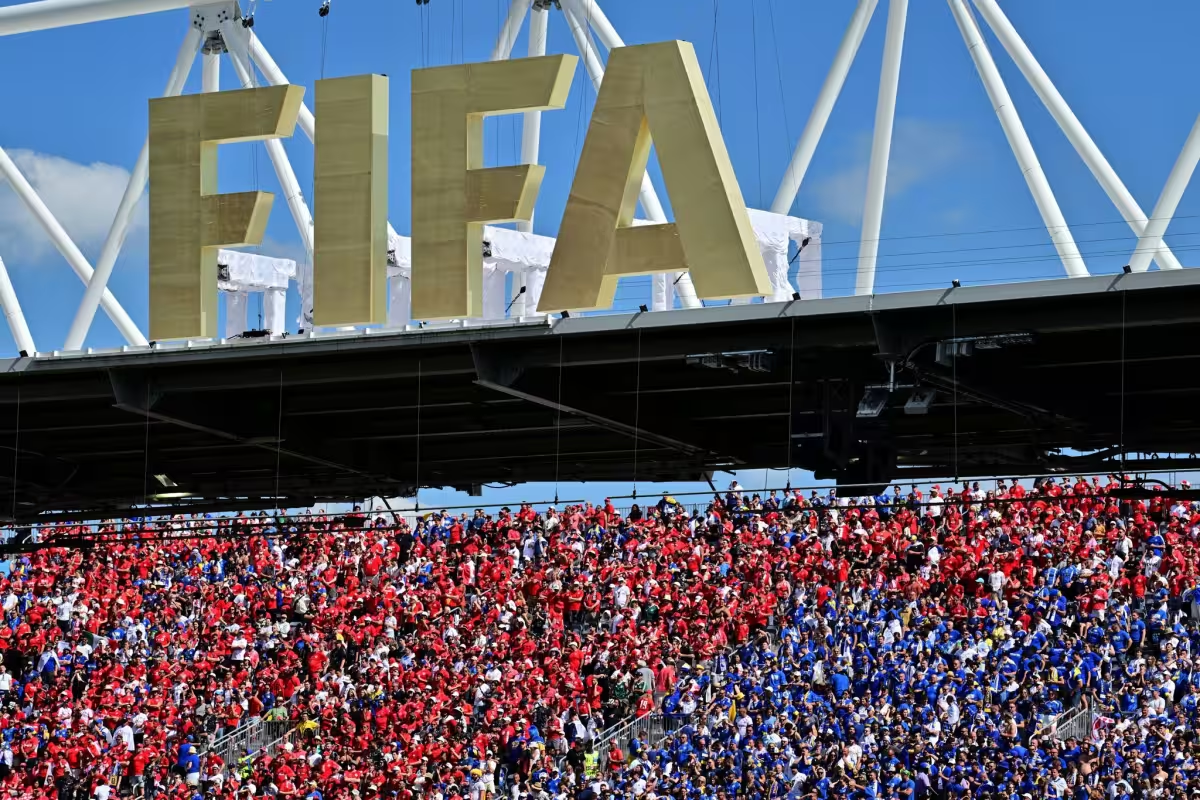


Organizers say these changes and tools are meant to make offside decisions cleaner for referees and more transparent for viewers. “I think what’s so exciting about this World Cup is that there are a bunch of new rules that are being implemented that nobody has actually seen implemented before, so we’re all going to be learning about them and seeing them in action in real time altogether,” a commentator on the tournament said, underscoring that fans and officials will be discovering operational details as matches unfold.
That promise of clarity meets a persistent problem: offside rules have evolved and still read as arcane to many casual viewers. The friction is obvious — the official standard demands split-second judgment about body parts and positioning at the instant the ball is played, while broadcasts and social commentary try to make those judgments feel immediate and absolute. Introducing a semi-automated system aims to bridge that gap, but the rulebook’s core — penalizing a player at the precise moment a teammate touches the ball and measuring inches of body ahead of the last defender — remains the governing standard.
Practical consequences for matches are immediate and unavoidable. Every one of the 104 World Cup games this year will use the updated framework: referees will apply the offside rule when the ball is touched or played by a teammate and, where an offside is called, the indirect free kick will be the restart. Players and coaches must adapt tactics that hinge on whether a forward can be put onside by a pass or left behind by split-second movement.
The biggest operational question is also the clearest unresolved one: how will the semi-automated offside system operate alongside the referee’s instantaneous judgment about the moment of the pass and the inch-by-inch body measurements that currently decide calls? That integration — the procedural detail of how technology and on-field officials share or defer authority during live play — will be the change that actually determines whether the new approach reduces confusion or merely shifts it into a different box score. Fans will see the answer unfold across this tournament’s 104 games, and how referees and the system interact will determine whether offside finally becomes easier to watch — or just easier to debate.