



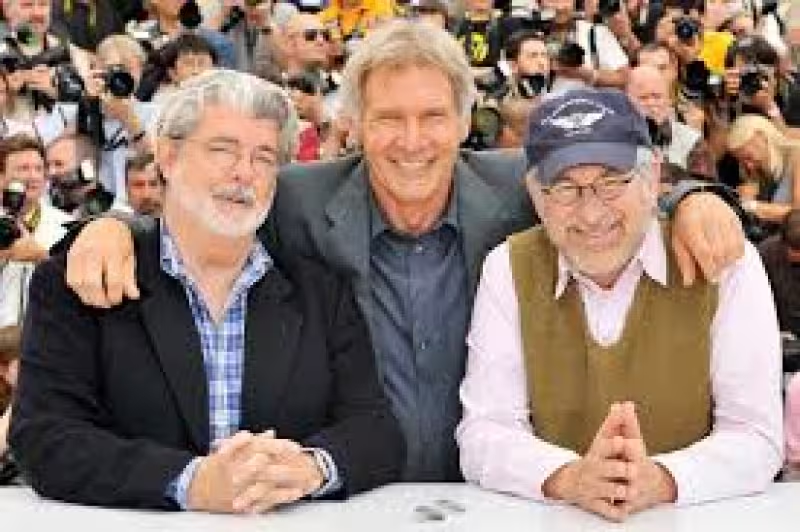
“Crystal Skull was a tough production for Janusz. Steven was struggling with that movie. Harrison was struggling with the movie. They didn’t want to do a Raiders movie that involved aliens, and they kind of got into a fight with George about it,” Kathleen Kennedy recalled, putting the 2008 sequel’s creative split in blunt terms.
Kennedy’s account names the fracture at the center of Indiana Jones and the Kingdom of the Crystal Skull: the franchise’s creator pressing a science‑fiction turn while his lead actor and director pushed back. The result, she implies, was a production riven by doubt and disagreement as the film moved into the 1950s setting Lucas favored.

George Lucas has said he “wanted it to be kind of a War of the Worlds sort of thing,” and that the 1950s backdrop made the flying‑saucer idea feel natural. He also recounted both principal collaborators voicing a hard refusal: “Harrison said, ‘I’m not going to do another science-fiction movie.’ And Steven said, ‘I’m not going to do another science-fiction movie.’”
That standoff forced multiple rewrites. Lucas said they did about five scripts before he and Spielberg reached a middle ground: “Look, what if they’re not aliens but from another dimension.” The compromise steered the final film away from an outright alien invasion conceit without abandoning the science‑fiction impulses Lucas wanted to explore.
The weight of Kennedy’s telling is in the specifics: Janusz Kamiński, the cinematographer; Spielberg, the director; Ford, the star — all struggling. Kennedy’s listing of names makes the disagreement not an abstract clash of tastes but a practical problem on set, one she describes as a fight with Lucas about the film’s soul.

Context explains why that fight mattered. The first three Indiana Jones pictures leaned into the supernatural rather than hard science fiction, and moving the series into the 1950s opened a different set of cultural references — flying saucers, Cold War paranoia, a new visual palette. The film released in 2008, has a 77% rating on Rotten Tomatoes, was not a critical disaster on opening and earned strong box‑office returns, but it has remained divisive among fans since.
The tension between Lucas’s instincts and Ford and Spielberg’s reluctance is the creative friction the film could not smooth entirely. Kennedy’s summary — that both star and director resisted an explicitly alien Raiders — clarifies why viewers found the movie uneven: it is the product of a visible compromise rather than a single, unified creative push.
Kennedy also tied that period of unease to later franchise decisions. She connected the creative strain around Crystal Skull to Harrison Ford’s return for Indiana Jones and the Dial of Destiny, suggesting the 2008 production’s difficulties carried forward into how the filmmakers approached the next chapter.
Ford himself defended Kingdom of the Crystal Skull ahead of Dial of Destiny, a public stance that complicated the narrative of a split. Even so, the record Kennedy recounts — a creator wanting a War of the Worlds riff, a director and star balking, five scripts, then a compromise that recast the threat as something “from another dimension” — explains why the film landed where it did: neither the straightforward science‑fiction picture Lucas imagined nor a pure Raiders follow‑up.
The bottom line: the alien debate changed the film’s shape. The compromise — not aliens but another‑dimension explanation — is the practical answer to what happened; the unresolved question is how much that fight over tone altered specific scenes and choices in the finished film. Kennedy’s remarks make clear that the dispute was not a footnote but a production fault line whose aftershocks reached into the next Indiana Jones installment.



