



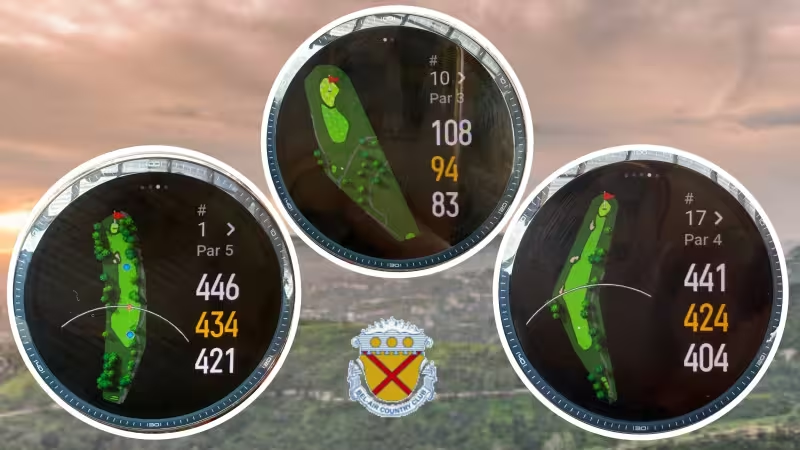
The Curtis Cup is being played this week at Bel‑Air Country Club in California, where the United States and GB&I amateur teams arrive for a competition framed less by length than by subtlety.
Bel‑Air is short by modern championship standards — 6,284 yards — but the numbers understate the challenge. GB&I arrive off a morale-boosting win at Sunningdale in 2024, and the course’s compact yardage forces players into a game of precision. As Catriona Matthew put it plainly: "the real test will be the greens and distance control".

The venue itself is an historic layout carved out of the canyons of the Santa Monica Mountains. On grass that can run quickly and slopes that hide subtle breaks, success will hinge on placement as much as power. Players who can put the ball on the correct side of a fairway will have angles to attack pins; those who miss will be left with awkward distances into treacherous, fast surfaces.
Bel‑Air looks inviting from a distance — wide fairways, tree-lined holes and a scenic setting — but the course’s undulations, the pressure of a team match and the speed of the greens make it a difficult strategic test. The yardage book matters here: short, well-placed approaches and a touchy wedge game are worth more than pure length off the tee.



Practical details will shape pairings and tactics. A sharp wedge game from 120 to 130 yards is singled out as especially important at Bel‑Air; many scoring opportunities and recoveries will come from that zone. Equally critical is the art of keeping the ball below the hole on fast greens — a missed speed read or an uphill lip can turn a birdie chance into a costly bogey.
The first hole gives a concentrated example of the course’s decisions. It is a par 5 played from an elevated tee, offering views of the Los Angeles skyline, and it measures 495 yards from the Gold/Back tees, 460 yards from the White tees and 435 yards from the Red tees. Longer hitters may see a chance to reach in two, but the hole also rewards conservative strategy: an easy hybrid off the tee can be the right play, particularly for higher‑handicap golfers who want to avoid the canyon-side trouble.
Match captains will face real choices about pairings and order of play. Teams that prioritize wedge precision and green speed management will likely outmaneuver opponents who rely on length. In foursomes and fourballs the margin for error narrows further; a single downhill putt left above the hole can flip momentum across an entire session.
What to watch when play begins is straightforward: which side controls the 120–130 yard window and who converts those chances on the quick surfaces. If the United States can force opponents into awkward distances off the fairways and then two-putt under pressure, they will test GB&I’s recent form. If GB&I reproduce the composure that won at Sunningdale and manage the small margins around the greens, the contest will stay tight.
The unresolved question heading into the week is simple: which team will handle Bel‑Air better? The venue hands an advantage to patient, precise play — and the team that adapts quickest to the course’s speed and angles will take the early lead when the first matches get underway this week.



