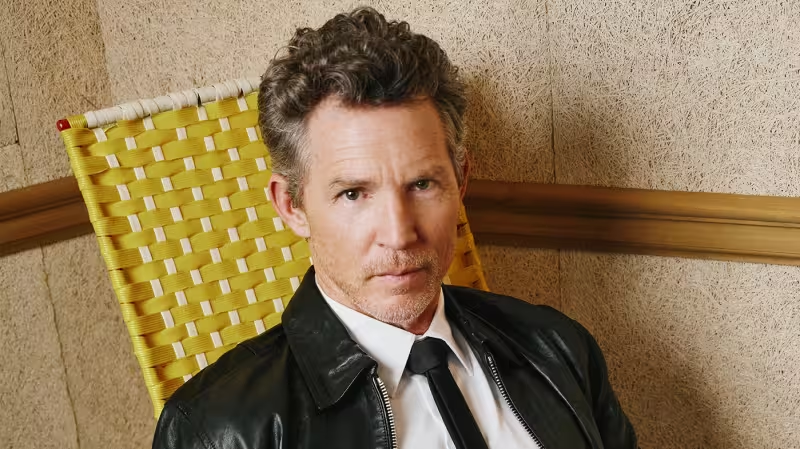
“I don't know how this happened,” Shawn Hatosy said bluntly about becoming what the internet has dubbed everything from “The Internet's Newest Babygirl” to “Silver Fox” and “Sex Symbol.” The three‑decade actor, who has moved between indie films and prestige television, admitted his sudden online fame feels accidental even as his guest turn on The Pitt keeps spiraling into wider attention.
Hatosy’s visibility rests squarely on Dr. Jack Abbot, the character whose first Season 1 appearance prompted immediate viewer affection and whose arc in Season 2 has intensified that response. Hatosy earned an Emmy for the guest role; viewers noticed the show leaning into Abbot’s charm and dry wit, which Hatosy says “come from creator R. Scott Gemmill.”

Part of the current surge is plain and visual: in Season 2 a scene where Samira Mohan helps dress Abbot’s wound featured Abbot without a shirt. That moment, and the broader flirtation between Abbot and Dr. Samira Mohan, has been cited by fans as a flashpoint for the online reaction. Hatosy described the dynamic with his co‑star this way: “Supriya and I were told we don’t know exactly what it is, but there’s something there, and you could see it in the writing.” He also added, in a line that both reads like character and confession, “wasn’t made up.”
Screen chemistry with the show’s lead has mattered just as much. Hatosy pointed to a long personal and professional history with Noah Wyle as a foundation for the scenes that have drawn attention. “We’ve just been kicking around for so long. We’ve seen each other at the John Wells holiday parties for 20 years now,” he said, later adding, “There’s something about that chemistry when you just have a level of trust and understanding of each other.” That trust, Hatosy said, lets him make bold choices: “Being in a scene with Noah, I never stress about those scenes. I feel very free. I feel like I have no inhibitions about choices and I can take big risks.”
Those risks land in part because Abbot often acts outside the buzz of procedure. “Because it’s not about medicine in those moments, it’s about survival,” Hatosy said, describing why quiet exchanges—an emergency‑contact reveal in the final two episodes of Season 2, or the terse line “And I don’t want to be contacted”—cut through the usual medical‑drama clutter and register with viewers.
Hatosy’s trajectory explains why a moment can stick. He has spent three decades in the business, with early film roles in titles like The Faculty and Outside Providence, a lead on the TNT crime drama Southland and a subsequent arc on Animal Kingdom. That history makes the current attention less an overnight miracle and more a late‑career convergence: a carefully written part from a venerable creator, a veteran actor comfortable with risk, and a single, striking scene that gave fans something to clip, caption and circulate.
There is, though, a clear tension running through how Hatosy describes the phenomenon. He insists the Mohan‑Abbot connection “wasn’t made up” while also saying the flirtation “was not guided in detail by the writers.” In plain terms: the show’s creators signaled there was something between the characters, but left room for actors to find the specifics on camera. That gap—between a writerly hint and what performs as irresistible chemistry—helps explain why Hatosy can truthfully say he “doesn't know” which precise element sparked the internet reaction.
What comes next is less a plot point than a momentum test. With Season 2 concluded, the fragments that made Abbot a social‑media phenomenon—the shirtless wound scene, the emergency‑contact confession, the Wyle‑Hatosy rapport and Gemmill’s distinct voice—remain in the public feed. Hatosy’s answer to how the attention started is honest and unornamented: he doesn’t know. The evidence on screen, however, points to a particular mix of performance, proximity and a scripted invitation to intimacy—enough, for now, to keep viewers and the industry watching what a long career and a single role can suddenly amplify.