



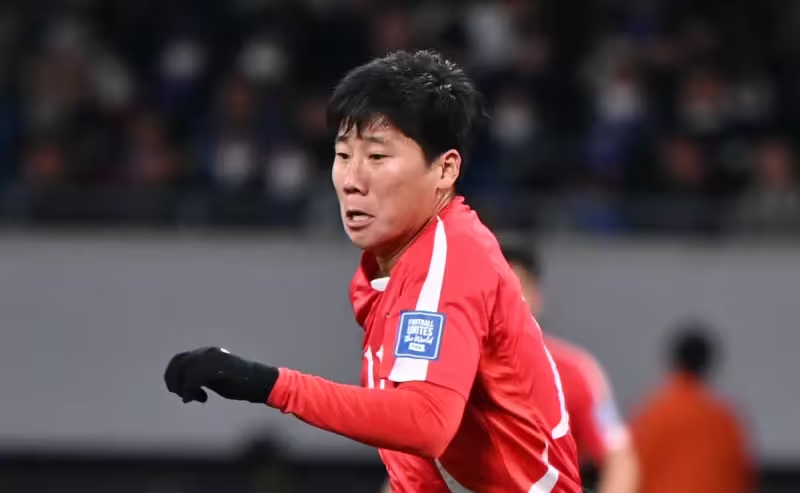
North Korea failed to qualify for the 2026 World Cup after finishing last in its AFC third-round group, ending its campaign with five points and mathematical elimination from the expanded tournament.
The outcome was clear in the standings: Iran topped Group A with 24 points, Uzbekistan followed with 21, the United Arab Emirates collected 15 and Qatar 11, while Kyrgyzstan finished just ahead of North Korea with six points to the DPRK’s five. Those totals left North Korea sixth in a six-team pool made up of Iran, Uzbekistan, the United Arab Emirates, Qatar and Kyrgyzstan.

The immediate mechanism behind the elimination is straightforward. Despite advancing from the second round — where North Korea beat Syria 1-0 and Myanmar 4-1 to finish second in Group B with nine points — the team could not accumulate enough results in the third round. The group was compact and unforgiving: only the top finishers secured the region’s direct slots, and North Korea’s five-point return from the set of matches was not enough to keep pace with established rivals.
Context matters here. The 2026 World Cup will be the first 48-team edition, staged in the United States, Mexico and Canada, with Asia allocated eight direct spots. That expansion broadened the field and raised expectations that more Asian teams might make the finals. For North Korea, however, the route had been complicated by an episode in March 2024 that left a blemish on the qualifying record. The national side refused to host Japan in Pyongyang, citing concerns over bacterial infections, and FIFA awarded Japan a 3-0 walkover while imposing a financial fine on North Korea after the hosts failed to find a neutral venue in time.



The friction in North Korea’s story is the gap between resilience and consequence. The team still advanced from the second round after real wins over Syria and Myanmar, yet the forfeit and fine reduced margin for error and complicated preparations heading into the decisive phase. In short: the side recovered enough to reach the third round but not enough to convert that chance into a place among the eight Asian qualifiers for 2026.
The practical consequence is twofold. For the wider Asian picture, one more potential entrant did not take advantage of the enlarged allocation, leaving the continent’s eight direct slots to be filled by other teams. For North Korea, the failure to qualify is a reset point — the campaign that might have looked more promising in a larger field still fell short when confronted with a difficult group and earlier disciplinary setbacks.
What remains unresolved is concrete and immediate: the national team’s next competitive step is not confirmed. There is no timetable in the available record for when North Korea will return to the international calendar or how it will address the organizational and disciplinary issues that affected the campaign. The most consequential unanswered question now is whether the federation can reorganize to close the gap with regional rivals before the next World Cup cycle and renewed AFC qualifying, and how long that process will take given the recent forfeit and financial sanction.
For now, North Korea leaves the 2026 qualifying chapter as a footnote to the broader shift in world soccer — the World Cup will expand to 48 teams across three countries in 2026, but the extra spots did not translate into a berth for the DPRK. The team's elimination is final in this cycle; the timeline and strategy for a comeback remain to be seen.



