



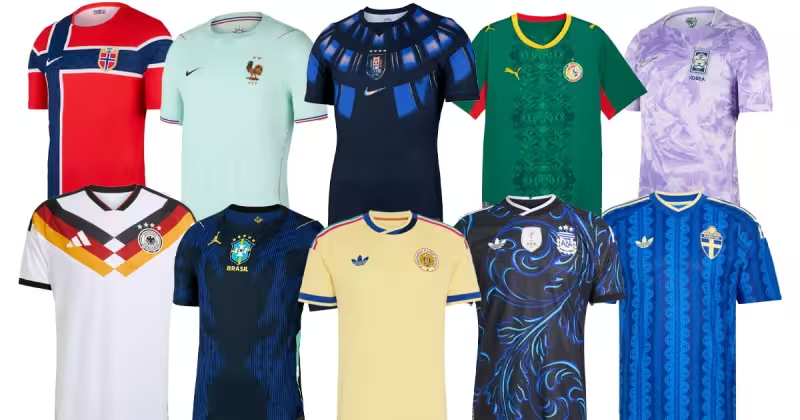
The Athletic has published a Style of Play feature that ranks every home strip for the men’s 2026 World Cup, turning the tournament’s uniforms into the subject rather than the backdrop of coverage.
The scale is decisive: the 2026 men’s World Cup will feature 48 teams across 37 days, which gives the ranking a much larger catalogue to work through than any previous edition. That surplus of kits is the project’s basic fact and its selling point — more nations means more designs, more retro revivals, and more moments when a shirt becomes the story.

The Athletic frames the series as kit culture reporting and places the ranking inside that frame. The outlet wrote: "The men’s World Cup will be many things: searing elite-level competition, a monument to hypercapitalism and, for better or worse, a fashion show." Within that sentence sit two claims at once: the tournament will still be sport first, and it will also be a global merchandising event with style as its secondary competition.
Practical readers will want two answers from the project: what exactly The Athletic is ranking (every home strip) and how big the field is (48 teams, 37 days). The ranking promises assessments for each country’s home colours, placing them on a single scale of taste, cultural resonance and design clues that collectors, retailers and fans can reference as runs of merchandise and limited drops ramp up ahead of the tournament.


The series is sponsored by the Active Cash Visa Credit Card from Wells Fargo. The Athletic also states that it maintains full editorial independence from the sponsor, that partners have no control over or input into the reporting or editing process, and that partners do not review stories before publication. That explicit separation is part of the piece’s framing: the reporting treats commercial context as an on-the-record fact rather than an off-stage influence.
Still, the proximity of sponsorship and the subject matter creates an unavoidable friction. A ranking of shirts sits at the intersection of taste-making and commerce; the more attention a kit receives, the more commercial value it can generate. A reader can accept The Athletic’s declared independence and also note that the project’s premise — evaluating designs in the run-up to a mass-market event — plays to the same engines that sell jerseys, collectibles and hype drops.
For fans searching for where the USA World Cup Jersey falls in that hierarchy, the feature promises a definitive entry: an assigned place and a short assessment for every home kit. This summary can confirm only the structure and the stakes; it does not reproduce The Athletic’s full list or identify which shirt tops the ranking. That absence is the story’s central gap.
The next step for anyone tracking kit narratives is straightforward: consult The Athletic’s Style of Play ranking for the full, team-by-team breakdown. How a top choice reads — which country earns the number one spot and whether a high-ranking shirt translates into sales or cultural momentum — will be the detail that turns this project from a design exercise into a measurable influence on fandom and merchandising during the 37 days of the tournament.



