



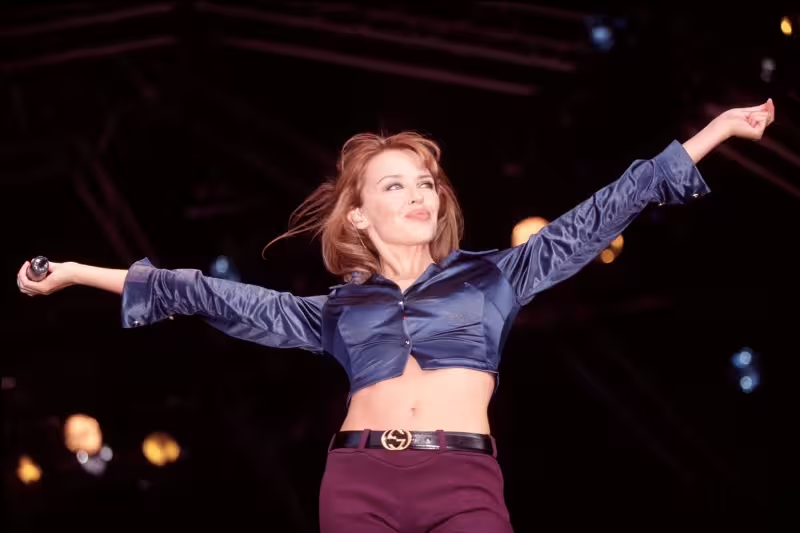
“We were good together — shoulda, coulda, woulda, whatever,” Kylie Minogue says in Kylie, the Netflix documentary released this week that revisits a life lived in pop’s glare. In a film described as a tribute to her allure, Minogue returns to the late‑1980s romance with Michael Hutchence and the era that followed; those two wild years from 1989 to 1991 remain a hinge in the story she tells on screen. “It was definitely an amazing point in time,” she adds, and later admits, “I’ve probably been looking for something like that ever since, and I haven’t got it.”
The documentary lands as Minogue’s career is riding a renewed commercial and cultural wave. The 2020s revival that began with “Padam Padam” has rippled through clubs and feeds — the single set off a level of fan mania that has been dubbed the “Padamic” — and the momentum carried into Tension and its follow‑up, Tension II. Those records lean into a Euro‑sleaze dance vibe and have reinserted Minogue’s songs into a global dance floor conversation while reminding listeners that the artist who first broke out from the Australian soap Neighbours in the 1980s still writes hits for wedding receptions and late‑night dancefloors alike.

What proves the documentary’s timing is how those decades stack in a single career: a debut single, “I Should Be So Lucky,” written in a matter of minutes and released in 1987 after she began working with the U.K. production team Stock Aitken Waterman; cult detours such as 1997’s Impossible Princess; and later experiments like 2018’s Golden. The film stitches those eras together, racing from bubblegum pop to artful reinvention to the present Padam‑driven revival.
The account the documentary presents is not without its frictions. Nick Cave, a longtime friend, supplies a blunt verdict from the past: “She had everything but credibility.” That line sits uneasily next to the evidence of longevity. Minogue’s catalog contains both the instant pleasures that made her famous and the riskier, cult favorites critics point to when they talk about artistic growth. The contrast — pop stardom that could be written off as manufactured versus an artist who quietly built an eclectic body of work — is the documentary’s dramatic arc.
Small contradictions follow Minogue through the film. The story of “I Should Be So Lucky” is itself a tiny dispute: Minogue says the song was written in 40 minutes, while the producer recalls two hours. It’s the kind of detail that matters less for accuracy than for what it reveals: the industry’s churn, the mythmaking around pop origins, and the ways memory sharpens or softens over time.
Tracing Minogue’s partnerships and romances, the documentary foregrounds her relationship with Hutchence as more than gossip; it’s presented as a formative chapter that continues to reverberate. Hutchence died in 1997, the same year Impossible Princess arrived, and the film treats those losses and risks as connective tissue rather than as isolated anecdotes.
For audiences asking how Kylie Minogue has managed sustained fame where many peers have faded, the documentary supplies a composite answer: she has been adaptable, willing to trade safe hits for stylistic experiments and then return to the dancefloor with renewed focus. The recent Tension records are not a sentimental revival but a deliberate re‑anchoring of her voice in contemporary pop. “Padam Padam” did more than chart; it reframed her as a current force.
What the documentary does not provide is a next date circled on a calendar. Netflix’s tribute arrives with no announced follow‑up album or tour to carry the Padamic forward. That absence is the story’s sharpest open question: Minogue’s present standing — a rare pop veteran who still commands global attention — is cemented by the film and by two Tension albums, but whether the momentum will extend beyond Tension II depends on what she chooses next.
For now, the documentary does what a good career portrait must: it collects the seams and shows how they hold. Kylie Minogue emerges from it not as a legacy act resting on nostalgia but as an artist with a living, changeable career; the proof that this is more than a moment will come when she makes the next move — a new record, a major tour, or a project that turns the Padamic into a longer chapter in pop history.



