



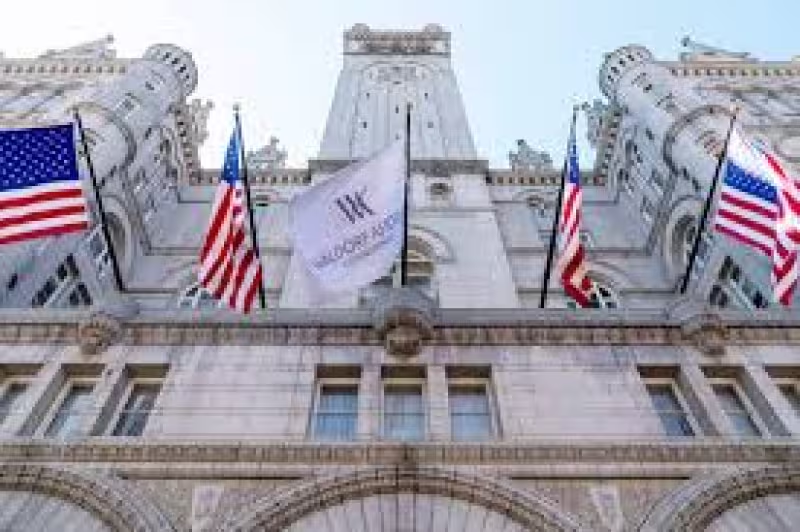
The General Services Administration announced Wednesday that it has sold the Old Post Office Building at 1100 Pennsylvania Avenue in Washington, D.C., a landmark structure long tied to high‑profile hotel operations and public access obligations.
The deal includes explicit protections: the GSA said the sale "permanently secured public access to the iconic clock tower while establishing strong protections for the building's architectural heritage through a binding preservation covenant." The transaction also carries a dedicated fine arts covenant that covers works on site, including Robert Irwin's 48 Shadow Planes and a historic Benjamin Franklin statue.

The Old Post Office, completed in 1899 and listed on the National Register of Historic Places, was the Trump International Hotel from 2016 to 2022. The Trump family firm sold the leasing rights for $375 million; later in 2022 the property reopened as the Waldorf Astoria Washington D.C. under Hilton management. Under the sale the hotel operation is expected to continue under Hilton through the existing long‑term operating agreement.
Federal officials said the sale moves forward under the terms of the existing ground lease. Under that lease, BDT MSD Partners holds a right of first offer. People familiar with the matter say the building and land changed hands in a transaction that involved approximately $80 million in acquisition value, and those same people say discussions are underway about a possible resale of the property for roughly $400 million.
The preservation and public‑access terms are the immediate legal weight of the announcement: they lock in physical protections—limits on alterations and guaranteed access to the clock tower—that follow the property regardless of who holds the lease. They also bind the stewardship of the artworks that form part of the building's interior and public spaces, a notable point given the prominence of pieces such as Irwin's 48 Shadow Planes.
Contextually, the sale finishes a chapter that began when the Romanesque Revival building, originally the U.S. Post Office Department headquarters, was repurposed into a luxury hotel under a private lease. The new sale does not erase that history but it does transfer ownership under constraints designed to preserve the building's exterior and public functions while allowing hotel operations to continue.
The unresolved element—the friction in the transaction—is financial and procedural. People familiar with the matter say a bank or investment group that now controls the property is discussing a potential sale for about $400 million, more than four times the reported $80 million acquisition figure. That gap raises questions about who will hold long‑term control and how an eventual new leaseholder might balance commercial hotel interests with the preservation and public‑access covenants now embedded in the deed.
For Hilton, the practical consequence is straightforward: its long‑term management arrangement is expected to persist under a new leaseholder, according to people familiar with the negotiations. For the public, the consequence is legal certainty over access to the clock tower and the building's historic fabric; for preservationists, the binding covenant offers enforceable protections that outlast any single operator.
The single most consequential unanswered question after Wednesday's announcement is who will emerge as the final, long‑term leaseholder and whether a proposed $400 million resale will proceed. That outcome will determine which institution actually stewards one of Pennsylvania Avenue's most recognizable buildings while the preservation and public‑access rules announced by the GSA remain in force.



