



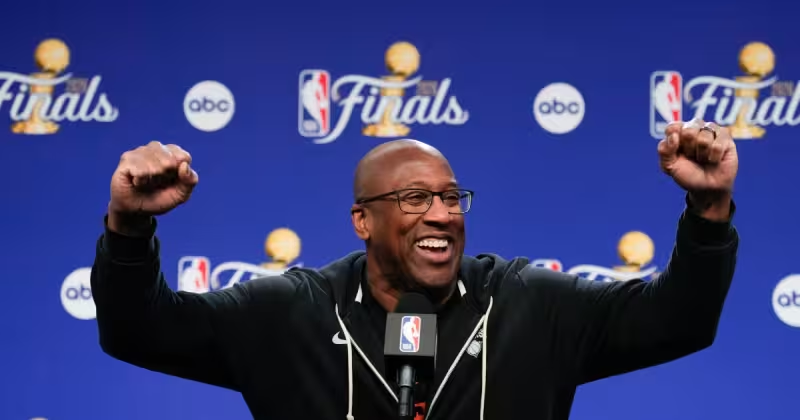
On a gray sideline at a middle school field, Mike Brown joked that he might be “the highest-paid film guy for any eighth-grade football team in the country.” He was talking about volunteering with the Westlake football program while still in the NBA orbit — a small, telling scene for a coach who has just steered the New York Knicks past the Cleveland Cavaliers and into the NBA Finals, leaving the Knicks two wins from a championship.
The result is brutally simple: Brown’s team beat the Cavaliers to advance. The Knicks were hired with one clear expectation — get this franchise to the Finals — and Brown has delivered on that objective. “Mike Brown was then hired with one thing, you better get them to the Finals,” Terry Pluto said, a blunt summary of the mandate that followed Brown into New York.

Pluto has been among Brown’s chroniclers and admirers. “He’s one of the most unpretentious guys, and I’ve never seen a guy just kind of roll, not just with the punches, with the body slams (of the NBA),” Pluto said. That steadiness, plus a coaching identity built on defense and an adapted old-school high-post offense, is the practical recipe the Knicks leaned on this postseason.
Brown’s résumé explains why skepticism and hope travel together. He began coaching LeBron James and the Cavaliers in 2005 and took Cleveland to the NBA Finals in 2007. He was a 35-year-old first-time head coach when the Cavaliers’ ownership placed a literal clock on him — Dan Gilbert wandered onto a podium and said, “Mike’s on the clock.” Brown answered then, “Oh, I understand that... all I can say is, you do your job, I’ve done mine.”
That exchange captures both Brown’s career arc and the churn that surrounds it. Pluto framed the broader NBA reality plainly: “The average lifespan of a coach in the NBA with its team is three years... This is nuts. These people are crazy in the NBA.” Brown has been fired before contracts ran out — in Los Angeles, in Cleveland twice, and in Sacramento — and he collected about $2 million from the Cavaliers the first time he was dismissed.
The friction in New York has its own shape. The Knicks had fired Tom Thibodeau after he took them to the Eastern Conference Finals for the first time in 25 years; the front office believed he was not the guy to reach the next step. Pluto put it this way: “He was actually hired in a tough spot in New York because the previous year, a coach named Tom Thibodeau, had taken the Knicks to the Eastern Conference Finals for the first time in 25 years, and they fired him because they felt he wasn’t the guy to get them to the NBA Finals.” Brown’s success on the court only sharpens that contradiction — a coach ousted after historic progress, another brought in explicitly to finish the job.
Brown’s methods are visible in small, concrete ways. He’s known as a defensive coach who has adapted an old-school high post offense; Pluto explained that means “you put your big man at the top of the key, throw him the ball, and there’s a bunch of guys picking and moving around, and the big guy is passing the ball to others.” Pluto added, plainly, “His offense turned into a machine.” Off the court, Brown has been a fixture at local St. Edward games supporting his two sons; a photograph published by The Plain Dealer captured him on the sideline with water bottles, coaching as much as spectating.
Now comes the decisive measure. Brown was hired to reach this stage, and he is two wins from a championship. The single, unavoidable question for the Knicks’ front office and for Brown’s defenders — the one that will determine whether this moment becomes stability rather than a headline — is whether a title will cement him in New York. Like any spurs head coach or coach in this era, Brown’s margin for error is wafer-thin; a ring would be the clearest answer the organization could offer to critics and a fitting capstone to a career that began with a young coach and a literal clock on his back.



