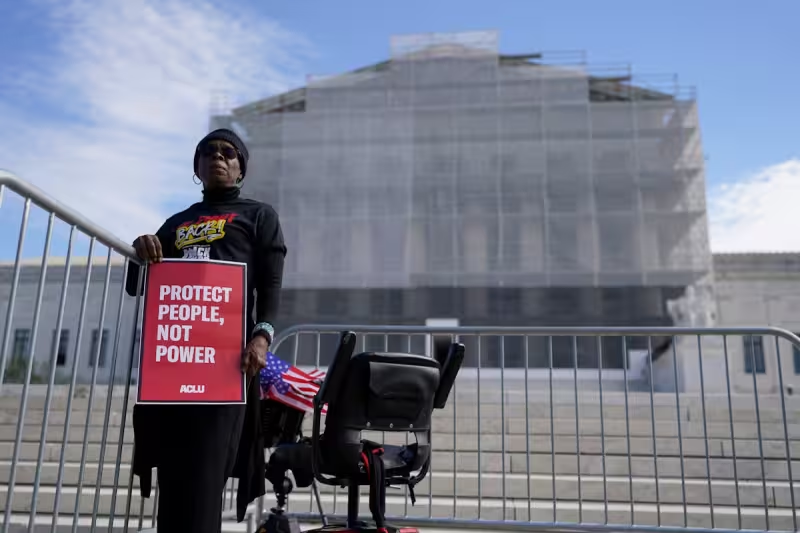
The Supreme Court’s Louisiana v. Callais decision cuts into Section 2 of the Voting Rights Act where it has been used most often: local government. The ruling matters most for school boards, city councils and other local election systems that can be challenged when voting rules produce racial discrimination.
Section 2 bars state and local governments from adopting voting rules that have that effect, but its biggest use has been in local cases, not statewide redistricting. Justice Ketanji Brown Jackson said in dissent that the court’s approach could make the provision “all but a dead letter,” a warning that captures how much harder the law may now be to deploy where it has done the most work.

David Tyson Jr. learned how central that local fight can be when he sued Richardson Independent School District in Texas in 2018 under Section 2. Tyson was the only person of color ever to serve on the district’s school board in its 164-year history, even though white students made up less than 30 percent of the district and Black and Hispanic students made up nearly 60 percent at the time.

Tyson described a “tale of two districts.” In the district’s higher-performing elementary schools, where at least 70 percent of students met grade level in two or more subjects, campuses were two-thirds white and mostly not economically disadvantaged. The lowest-performing elementary schools were largely Black, Latino and economically disadvantaged, with a 60-point achievement gap separating the district’s best and worst schools.
That contrast showed why Section 2 has mattered in local politics: Richardson’s school board remained persistently white because of the district’s voting practices, even though white students were a minority in the schools. White voters still formed a majority of the district’s population, which helped preserve a board that did not reflect the students it governed.
The public debate around Louisiana v. Callais has centered on Congress and the 2026 midterms, but the sharper effect may land much closer to home. Local governments are where Section 2 has most often helped create representative school boards and city councils, including places where racial minorities are local majorities and can translate numbers into seats.
What remains uncertain is how far lower courts will let plaintiffs go with Section 2 after Callais. The law still exists, but the ruling leaves open whether local governments will still be able to rely on it as a practical tool, or whether the path to challenging discriminatory voting systems will now be much narrower.