



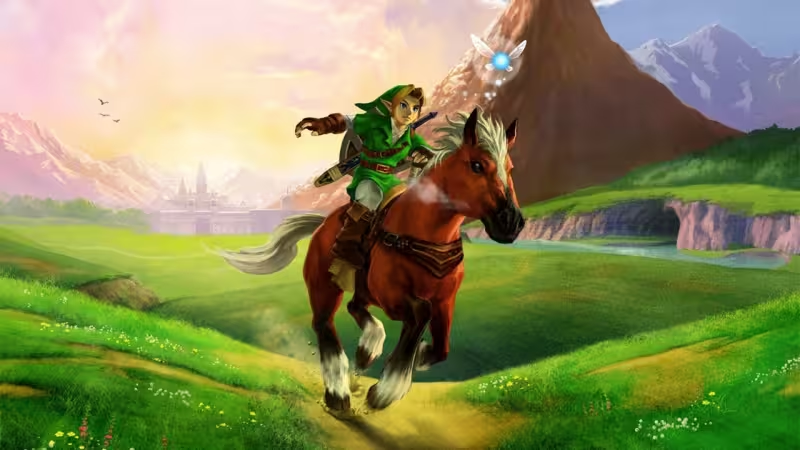
Nintendo announced a remake of The Legend of Zelda: Ocarina of Time for Nintendo Switch 2 during the June 2026 Nintendo Direct, and said the game will launch in 2026.
The reveal framed a high-profile return: Ocarina of Time first arrived on the Nintendo 64 in 1998 and is widely regarded as one of the most influential 3D adventure games. Nintendo highlighted that the remake abandons the painting-like visuals of Breath of the Wild and Tears of the Kingdom in favor of a new art direction, and the short trailer shown in June 2026 offered almost nothing else—just a tapestry and a sleeping Link.

That combination—an unequivocal confirmation of a remake plus a near-empty trailer—carries weight because of the original’s place in gaming history. Ocarina of Time changed the series from 2D top-down play to full 3D environments and introduced mechanics such as target lock and context-sensitive buttons; a 2026 remake places those landmarks on a current hardware roadmap and brings them to a new generation on Nintendo Switch 2.
For readers wondering what versions already exist, the record is straightforward: the original game launched on N64 in 1998, Nintendo reissued it for GameCube in 2003 with Master Quest as a pre-order bonus for The Wind Waker, and an enhanced edition arrived on Nintendo 3DS in 2011. The base game is also available to play on Nintendo Switch and Switch 2 through the Switch Online + Expansion Pack membership, meaning players can access the original experience immediately while they wait for the remake.


The remake’s art-style departure is the clearest new detail Nintendo offered. Where Breath of the Wild and Tears of the Kingdom favored a painterly, open-world look, the new footage indicates a different visual treatment—Nintendo did not say whether that will affect tone, scale, or how landmarks and characters are rendered. The company likewise gave no specifics on which systems from the original will be preserved, altered, or expanded for modern controls and hardware.
That absence is the story’s friction. Nintendo presented the project as a major reveal yet revealed almost nothing beyond a visual pivot and a 2026 launch window. For a title that historically rewrote how 3D adventure games play, the lack of detail leaves several obvious questions unanswered: will the remake keep the original camera and lock-on feel, will it rework dungeons for modern design expectations, and how closely will new visuals map to classic level geometry? Nintendo has not addressed any of this.
Practically speaking, the announcement matters now because it sets expectations for the platform’s early catalog and the series’ 40th anniversary year. A 2026 release on Switch 2 gives Nintendo a marquee franchise to showcase the new console’s capabilities, and it offers longtime players a chance to revisit a foundational title without relying on emulation or legacy hardware.
What to watch next is simple: further Nintendo presentations or direct updates that confirm how the remake will play, whether new content or quality-of-life changes are included, and a precise release date. Nintendo has fixed the year and the platform, but not the features that will determine whether this is a faithful restoration, a graphical overhaul, or a deeper reimagining.
Until Nintendo supplies those specifics, the clearest conclusion is this: fans have a confirmed Switch 2 remake in 2026 and very little else. The next Nintendo Direct or follow-up announcement will do the real work of telling players whether Ocarina of Time’s signature mechanics and dungeons will arrive intact, nudged, or reshaped for a new era.



