



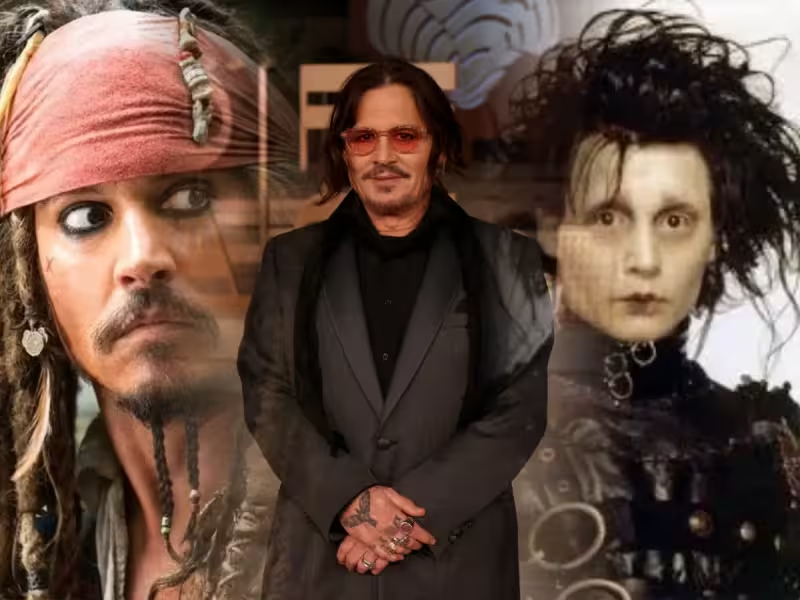
Johnny Depp turned 63 on June 9, a birthday that invited retrospection more than celebration: his career is now measured in characters — some quietly human, some outrageously strange — that have lodged in the cultural imagination.
Depp's resume reads like a catalogue of distinct transformations. He played Captain Jack Sparrow in the Pirates of the Caribbean franchise, a performance that earned him his first Academy Award nomination for Best Actor. He was the pale, gentle outsider in Tim Burton's romantic classic Edward Scissorhands and the whimsical confectioner Willy Wonka in Burton's 2005 family fantasy. In 1993 he broke out as Gilbert Grape in the comedy-drama Gilbert Grape, and later took on the title role in Ed Wood, a biographical comedy-drama. He also portrayed Sir James Mathew Barrie in a biographical drama about the creation of Peter Pan and played real-life FBI agent Joseph Pistone in a crime drama; Pistone went undercover as a jewel thief to infiltrate the New York Mafia, a film in which Al Pacino appeared as Benjamin Ruggiero.

The birthday functions as the prompt rather than the point: it is a moment to reassess why Depp, across several decades in the public eye, became described as one of the most celebrated American actors, producers and musicians. Several of the parts that defined him were made with director Tim Burton, and together those films helped carry Depp from character actor to international stardom over a career spanning decades.


There is an obvious tension at the heart of that stardom. Depp is widely celebrated for range and daring even as many of his most famous turns hinge on peculiarity. Edward Scissorhands and Captain Jack Sparrow are not subtle reinventions of everyday types; they are figures built from eccentric traits and deliberate oddness. The contradiction — a mainstream, award-nominated film star whose signature performances often trade in the uncanny — is what makes revisiting his filmography feel less like list-making and more like trying to explain one artist's repeated decision to live on the margins of convention.
For fans and filmgoers the list of landmark roles answers the immediate question of what made Depp a defining presence: memorable parts in high-profile films that ranged from intimate drama to large-scale fantasy. For the industry it is an inventory of bankable singularity — performances that could anchor studio franchises and art-house biographies alike. Yet the birthday also exposes a gap: beyond the retrospective attention, there is no single new project or public appearance attached to this milestone in the material at hand.
At 63, Depp's legacy is both clear and unsettled. The films named on this occasion — from Gilbert Grape to Willy Wonka, from Ed Wood to Pirates of the Caribbean — stand as the measurable achievements of a career, but the next chapter is not spelled out here. The milestone leaves two things in view at once: the durability of work that made him one of America's most celebrated performers, and the unanswered question of what he will choose to play next.



