



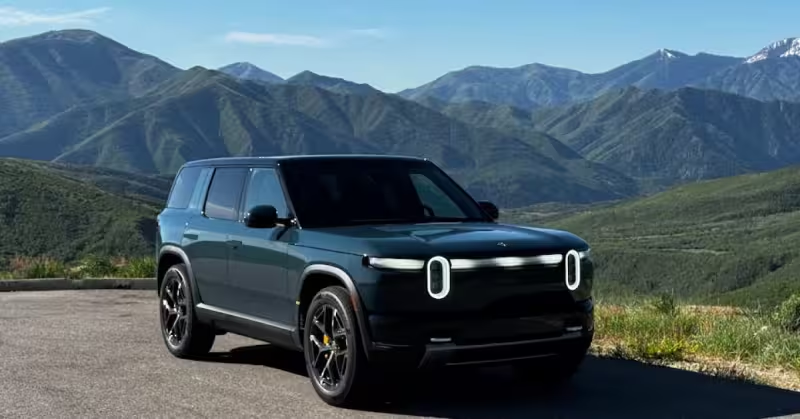
Rivian began delivering the R2 on the day of the article, putting its long-promised mass-market SUV into customers’ hands even as the company works to prove it can sell at scale. In Park City, Utah, a reporter spent five hours driving a performance variant and found an electric SUV that feels smaller, quicker and more accessible than Rivian’s larger R1S, but not as cheap as the company’s headline starting price suggests.
The R2 is meant to be Rivian’s wider-reach model, a two-row SUV that weighs about 5,000 pounds and measures 40 cm shorter overall than the R1S, with a wheelbase 15 cm shorter and a body 16 cm more compact. Rivian says the entry point will eventually be a rear-wheel-drive version with a smaller battery starting at $45,000, while the 88 kWh pack in the test vehicle sits in the middle of the lineup. The company’s pitch is simple: this is the vehicle that could pull Rivian into a much larger market.


That pitch runs into a familiar electric-vehicle reality. Rivian says the sales sweet spot is likely to be an all-wheel-drive Premium version that comes in above $55,000 once destination charges and other fees are added, pushing the model most likely to move off lots well past the price that headlines the launch. The R2 is still being framed as a mass-market SUV, but the version Rivian expects to sell best lands closer to premium territory, where the buyer pool is broader than the brand’s current lineup but still not truly cheap.
On the road, the performance version made its case the way Rivian wanted it to: with speed. The company says it will get from 0 to 60 mph in well under 3.6 seconds, and it backs that up with a chassis and battery package that aims to keep the truck-like heft out of the driver’s mind. The R2 can pull down up to 240 kW at peak charging, and Rivian says it should go from 10% to 80% charge in less than 30 minutes, adding around 230 miles in that window. That is not far off the fast-charging claims most buyers hear now, but it still trails 800V systems that can get from 10% to 80% in under 20 minutes, which means R2 road trips should be shorter than Rivian R1S trips but still about 10 minutes longer than stops in some rival EVs.
That gap matters because the R2 is supposed to be the vehicle that broadens Rivian’s reach. The company has promised it for years, and starting deliveries now gives it a real product to point to instead of a future plan. But the first drives also show the balancing act at the center of the launch: Rivian wants the R2 to look like an attainable family SUV, yet the version it expects to sell best sits well above $55,000, and the charging figures, while competitive, do not put it at the front of the pack. The next test is no longer whether the R2 can be built. It is whether enough buyers accept its price and its compromises for Rivian’s mass-market bet to work.



